You can apt-get install milter-greylist (which makes maintenance through OS upgrades manageble) and it has all the features that I would love to add in my series of hacks to graymilter but never got around to doing so.
“ο νέος ρόλος τον οποίο καλείται σήμερα να διαδραματίσει ο CIO, είναι ιδιαίτερα αναβαθμισμένος σε σχέση με το παρελθόν «αφού συμβάλλει ως μέλος πλέον της ηγετικής ομάδας, στη χάραξη της στρατηγικής της εταιρείας».”
Χαντρούλες στους ιθαγενείς, μια και όταν τα πράγματα είναι δύσκολα ο CIO κάνει operate (είτε inhouse, είτε outsourced) ένα cost center.
“ο CIO οφείλει σήμερα να συμβάλλει αποτελεσματικά στην ευθυγράμμιση του ΙΤ με το business με το να καταθέτει συχνότερα τις καινοτόμες προτάσεις του, μέσα από τις οποίες η εταιρεία του αποκτά το στρατηγικό πλεονέκτημα που της είναι απαραίτητο, προκειμένου να διαφοροποιηθεί σημαντικά από τον ανταγωνισμό.”
“Human interaction is a game, a dance, a playful thing that is deeply satisfying in itself” – John Gall
I got to read John Gall’s “Dancing with Elves” after reading his well known “Systems Bible” (for which I’ll blog another time). The book deals with strategies that one can use in order to influense kids in a positive way so as to achieve what the parent wants the kid to achieve. By that we do not mean to pre-plan the child’s life and then watch as the plan gets executed. This is not the plan. The plan is to overcome furstration (and disobedience) and find out strategies which will help the child arm itself before being released into the world as a responsible adult that does not require parental supervision.
I have to admit that the fifteen strategies presented in the book are interesting. They all strive to make the parent not say “no” or use any other negative, derrogatory or yelling arguments to have a point pass. Like the author says “don’t oppose forces- utilize them”. The strategies may seem conflicting, but Gall as an accomplished paediatrician undrestands that there is no unique strategy that would fit all children, or even one child all the time. So one of the first things that parents need to realise, is that you have to use the strategy that works at the given time and situation. And be prepared that it may not work some time afterwards. I think the message of the book is: Everytime you want to yell to make a point, can you do it without yelling? Here’s how.
a million ways *
A book about (systems) management
I do not know how well am I going to use advice from the book as a parent, but this book is more than a parenting book. It is a management one. At least within the IT business where childish, erratic or other BOFH style behavior is common. This occured to me when reading that
“although every picture tells a story, the story it tells may not be the same for everyone. The meanining of communication is what the other person makes of it, and that’s not necessarily the same as what you intended. It’s up to you to notice that. That’s your feedback.”
Compare the above to the everything is a DNS problem mantra. But then again there is also other management insight that most overlook:
“But what does it mean when you say a person is “just lazy” or “just stubborn”? It really means that you have tried out some of your repertoire of behavioral interventions in order to elicit desired piece of behavior from the other person and you have failed, because yoour repertoire was too limited.”
Yes dear manager of weird IT people, sometimes you have to admit that your repertoire is limited. You too have to change your approach to get the job done.
I loved the book. How could I not love a management book presenting itself as a parenting one which in the last pages includes the definition of the law of requisite variety?
[*] – image and phrase came from my twitter timeline, not from the book
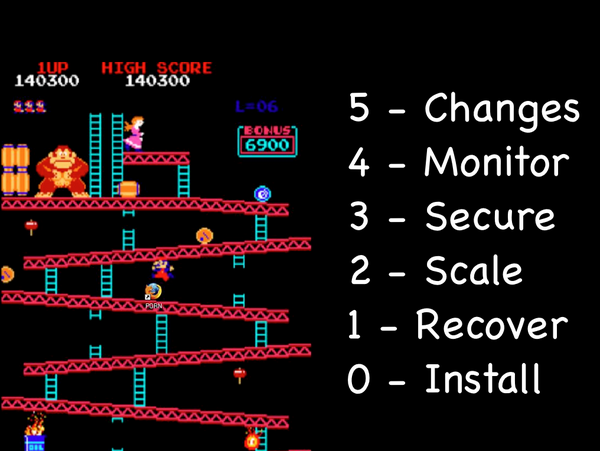
Regardless of how fun (and close to heart) it is, the analogy is flawed because it describes a sequence. We do not wait to compete all the steps in the ladder in order to get to the next level. Nor, do we restart only when a barrel hits us.
Fast transients is what we do. Fast transients is a term conceived by John Boyd and he first used it for air combat: “the ability to change altitude, airspeed and direction in any combination”. This is after all the essense of the Release Early; Release Often mantra. Push your system out in the wild so as to get a grasp of where the audience wants to direct it. Or plan for organized abandonment. According to Boyd, what matters most is the tempo of change: “fast transients suggeststhat -in order to win or gain superiority- we should operate at a faster tempo than our adversaries, or inside our adversaries’ time scales”1,2
So it is no wonder that I belive that although not so funny, the OODA loop describes how we work:
OODA Loop from CTOVision’s “I’ve got the OODA Blues”
Because as Boyd wrote:
“Orientation isn’t just a state you are in; it’s a process. You’re always orienting […] A nice tight little world where there’s no change – dinosaurs; they’re going to die. The name of the game is not to become a dinosaur […] If you are in an equilibrium position, you’re dead”
Now think of that in terms of what you do just to keep current with the tools of the trade and what you do in order to monitor, manage and evolve your infrastructure.
[1] – A vision so noble, Daniel Ford
[2] – Which reminds me of the Nyquist sampling theorem
You copy-paste your number series and the application displays a column chart of the occurences of the first digit and the theoretical occurencies expected.
The first 50 Fibonacci numbers and Benford’s Law
Use it and tell me what you think. Many thanks to Vaggelis Tripolitakis for finding the first bug. Be gentle with it as it runs as a free Google App Engine service. Depending on my free time and feedback I get, I may add the rest of the tests that Nigrini describes (second digit, last digit and first two digit distributions).
If you like it very much, you can buy me the kindle edition of the second edition of Nigrini’s book.
“Physics: there was the key. Record your observations. Apply physical principles.Speculate, but only trust proven conclusions. If I were to make any progress, I’d have to treat the task as a freshman physics problem. Time to update my notebook.” —Cliff Stoll, The Cuckoo’s Egg.
Recording observations. Updating notebooks. Something we computer people frequently forget regardless of the big data hype and logging infrastructures that we build.
Yesterday evening I was attending these gentlemen (four young unemployed guys trying to find their way by their description) at a Ruby meeting held at CoLab. Their presentation was split in two parts. The first part was about going from zero to a demo application in Rails in just over four months (and some of the development decisions they made).
The second part was about their idea. This part attracted most of the questions, so we got to learn about the original idea and a bit about how it evolved along with the hazards they had to deal with on Azzure and Amazon virtual machines working with literally a zero budget. But although untold, the story of the way that the team formed and operates was also presented. And while thinking about it, it struck me that it followed the Best and Luckenbill model from “Organising Deviance”:
Form of Organization
Mutual Association
Mutual Participation
Division of Labor
Extended Organization
Loners
no
no
no
no
Colleagues
yes
no
no
no
Peers
yes
yes
no
no
Mobs
yes
yes
yes
no
Formal Organizations
yes
yes
yes
yes
I would call these 4 young men Peers by the model above, because although some division of labor exists, it is not to the point of separation of duties yet. But while I am writing this, I am thinking that the parallels with the Best and Luckenbill model are to be expected. For what are startups if not deviant organisations aiming to disrupt the status quo in their own way?
deviance, n.:
a state or condition markedly different from the norm
I wonder how fast these guys are going to transform to a Formal Organization once they receive funding.

![[awaiting translation]](https://managing.blue/wp-content/uploads/2013/03/2013-03-19.jpg)



![dolphin, by girl[0]](https://managing.blue/wp-content/uploads/2013/02/dolphin.jpg)
 Managing organized complexity