
In August 6, 1991 Tim Berners-Lee posted his “WorldWideWeb – Executive Summary” on the USENET.
Tag: Internet
upgrade
There seems to be a shift in people’s perception of what a “computer person” does. While in the old days it would go like this:
– So you are into computers, right?
– Yes
– I have this problem with Word …
These days it goes like this:
– So you are into computers, right?
– Yes
– There’s this guy in Facebook. Can we trace him so that …
Is this an upgrade or what?
Update: It seems that I am repeating my self yearly. Then it was a neigbour. This time a friend of a friend. And in between I have been asked a number of times.
“Information wants to be free”
The European Commission cannot divulge these algorithms. However, the structure of VAT identification numbers is given in the table below.
As it happened I was looking for a method of verification of the Greek VAT identification numbers. All I knew was that it was a check digit algorithm. The above quote from the EC/VIES site shows, the algorithms are somehow “secret”. But as the old saying goes “Information wants to be free“. All it took was asking over at twitter and a bunch of links were sent to me describing the verification method. From them the one by @stsimb stands out as it points to open source code by GSIS (General Secreteriat of Information Systems).
So please member States, publish your algorithms. Obscurity only delays the innevitable information release.
Q: ITU botnet mitigation toolkit?
This was sitting in my drafts folder for quite some time. It seems that ITU has (had?) and effort to create a botnet mitigation toolkit. As the web page says:
The first draft of the background material for the project was made available in December 2007 with pilot tests planned in a number of ITU Member States in 2008 and 2009.
It is 2010 now, so does anyone have any more information on the toolkit’s progress?
The Dataverse Network Project
Μια και αρκετοί πια μιλάνε (και γράφουν) για ανοιχτά δεδομένα και κυβερνήσεις, διεθνείς οργανισμοί κ.ο.κ. ανοίγουν την πρόσβαση προς τα δεδομένα που παράγουν, μια ματιά στο Dataverse project είναι χρήσιμη.
[via]
IPv6 CIDR chart
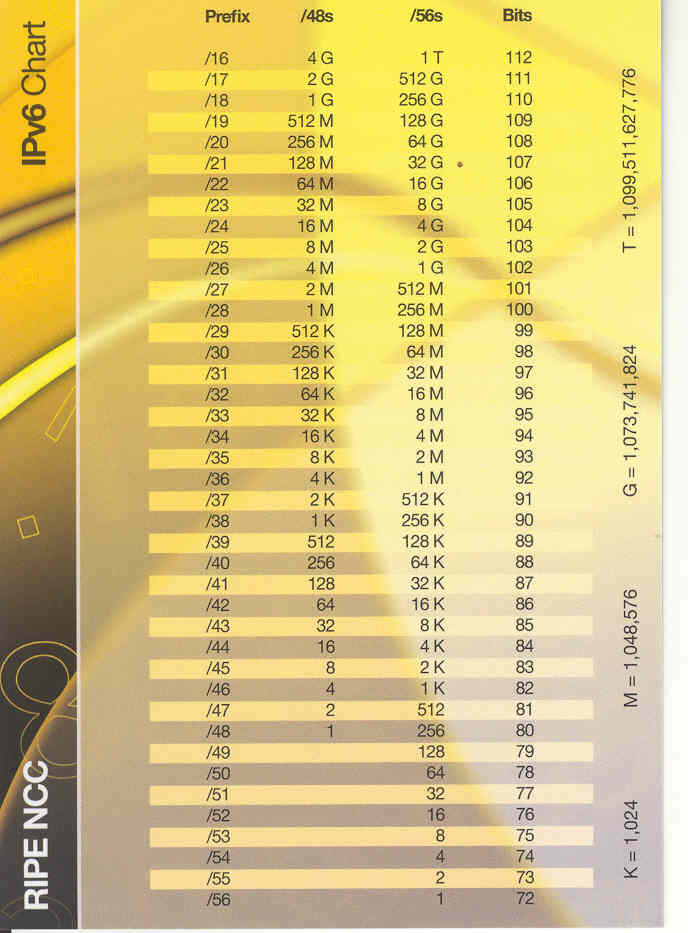
Also available: a printer friendly version. For an IPv4 version look here.
REX – the RIPE NCC Resource Explainer
Another gem from Thursday’s and Friday’s training course: REX – the RIPE NCC Resource Explainer. Historical data on IP space allocated to you by RIPE NCC, reverse DNS stuff, inclusion to blacklists and other interesting data is there. Highly useful when you need to document certain decisions or recommendations to higher management since they come from an unbiased trusted third party. The kind of stuff you expect RIPE NCC to give back to its members.
IPv6: an exercise
Today’s RIPE training course included a very interesting exercise:
We will run out of available IPv4 addresses before we run out of the need for IPv4. But we may be able to make more efficient use of the IPv4 addresses we already hold.
Within your group, think of areas in your network where you could reclaim IPv4 addresses. This can be done by changing some parts of your network to use private IPv4 address space, or you could change the way you have subnetteed, or some other way entirely…
Also think of which networks can already be completely migrated to IPv6 (not dual stacked!) without any problems.
You and your group have 10 minutes to come up with all reclaimable IPv4 addresses in your networks.
For each area, we’d like to know:
- advantages
- disadvantages
- feasibility
- amount of address space/time it will provide
Within these 10 minutes I was able to locate about 3 (maybe 4) /24 networks that could be reclaimed and I am sure that discussions with our routermasters will reveal some more. The time to act for IPv6 is now.
If we were to start all over again…
Terry Zink writes:
“If we were to start all over again, the designers of the Internet would not design it so that anyone could do anything.”
And how exactly do we know that?
The fact is that other more restrictive (with respect to anonymity and openness) systems co-existed with the Internet at the very same time it was developing. Yet the Internet prevailed because it was exactly this: Open providing interconnection between walled gardens and freedom to experiment.
If we were to start all over again, something similar would have emerged.
How? Where? What?
Reading Alec Muffett’s blog post on Google Chrome’s team decision to remove http:// as redundant geek speak from the browser, I think I cannot highlight enough the following piece:
“The URL represents “how://where/what” – how to retrieve some data, at where, and what the data is called”
Ah the joys of browser intelligence stupidity, while it tries to second-guess the user in order to help him. So when I type ftp.ntua.gr in the address bar, do I want to access it via HTTP or via FTP because the name starts with FTP? Do not second-guess the user because you are not helping him although you think you do.
And if the how:// part is not persuasive enough, let’s see the where part for which I have commented elsewhere. Users seem to expect that http://www.dom.ain should be identical to http://dom.ain. Instead of altering this expectation browsers tried to be helpful enough to connect to http://www.dom.ain when dom.ain does not respond and thus reinforcing it. Yay, right? No! Not only is the browser second-guessing the user, it also assumes the existence of http://www.dom.ain, and that a common administrative domain exists for both dom.ain and http://www.dom.ain. And then along come newer services, like for example OpenDNS that provides working pages for non-existent pages to the user’s dismay and irritation because what they get† is not what they asked for (but technically it is exactly what they asked for). This abstraction (and expectation) implies certain types of architectures that support the expected behavior and there is nothing that guarantees (or mandates) that such architectures are implemented. But hey, the browser is helping the user here by saving him from four keystrokes on two keys.
Since browsers are second-guessing both the how:// and the where, how long before they are going to second-guess the what too?
So please people, when trying to help by “improving” a user interface, ask yourself who (besides yourself) are you really helping. The Law of Unintended Consequences seeks opportunity.
[†] – If you want to be helpful, you do it the OpenDNS way: By giving the user choice. By removing choice for “convenience” you end up with misdirected user irritation, since the users tend to believe that not reaching a page is the administrators fault, where in fact it is the result of a series of choices done for years on behalf of the user without his consent. And we reach today, where the combination of an “intelligent” choice by the browser is incompatible with the user choice (using OpenDNS).]
 Managing organized complexity