re: Στρατηγικός και διευθυντικός ο νέος ρόλος των στελεχών Τεχνολογίας της Πληροφορίας

“Ομοφώνησαν ότι ο CIO πρέπει να σπάσει τη «γυάλινη οροφή» που τον κρατά κάτω από την ανώτερη διοίκηση. Παραδέχονται, όμως, ότι χρειάζονται καλύτερη επιχειρηματική εκπαίδευση και μεγαλύτερη εταιρική εμπειρία προκειμένου να γίνουν περισσότερο «στρατηγικοί». Μερικοί συμφώνησαν μάλιστα ότι ένας CIO μπορεί θαυμάσια να είναι ο φυσικός υποψήφιος για μια θέση ανώτατου διευθυντή, είτε του διευθύνοντος συμβούλου.”

(Σημείωση: Ομοφώνησαν == Groupthink)

Αυτά τα συζητάμε πριν από το 1999, είναι γραμμένα σε βιβλία χρόνια τώρα και εν τω μεταξύ το ταβάνι παραμένει και έχουμε γεμίσει με στρατηγούς χωρίς στρατιώτες και γραφειοκράτες. Όπως λέει και ο Nicholas Carr IT does not matter.

Ο Sun Tzu έχει κάνει ζημιά. Με το να διαβάσει κανείς το “Art of War” ή το “Περί Πολέμου” δεν γίνεται και στρατηγός, ειδικά επειδή διάβασε κάτι out of context. Το σκάκι προσφέρει πιο μετρήσιμα αποτελέσματα: Έχεις στη διάθεσή σου 16 εργαζόμενους με συγκεκριμένες δεξιότητες για να τα βγάλεις πέρα. Επειδή διάβασες τους κανόνες και δυο ανοίγματα, δεν είσαι και ο Fisher. Και έτσι καταλαβαίνεις τη διαφορά του “στρατηγού” από αυτόν που διάβασε την τρέχουσα προσαρμογή της “Τέχνης του Πολέμου” στο μάνατζμεντ. Αλλά είναι πάντα πιο εύκολο να συμμετέχει κανείς σε συζητήσεις και brainstorming για meta-strategies (“Τι καλά που θα ήταν εάν υιοθετούσαμε αυτή τη στρατηγική”).

Αν θέλεις να περάσεις τη “γυάλινη οροφή” πρέπει να ξέρεις το τερέν. Αν θέλεις να ξέρεις το τερέν, δεν πας για CIO, μαθαίνεις τη δουλειά end-to-end.

(In-Reply-To:)

Υπάρχει ταβάνι

“Ειναι αποριας αξιο πώς ολοκληροι ομιλοι στηριζουν το IT τους σε τραγικα ηλιθιους IT Directors.”

Αυτό εμφανίστηκε κάπου στο timeline. Θα επιχειρήσω μια προσέγγιση. Δεν είναι κάτι για να πέφτει από τα σύννεφα κανείς. Είναι κάτι το αναμενόμενο. Με την εξαίρεση οργανισμών που ασχολούνται με την Πληροφορική (και δεν εννοώ τους box movers) το ITιλίκι δεν είναι καριέρα. Δεν είναι μια διαδρομή που θα οδηγήσει κάποιον στα “ανώτερα πατώματα” της διοίκησης. Και γιατί να ήταν άλλωστε;

Μια τυπική πορεία ξεκινάει από τον τύπο που “τα φτιάχνει όλα” και τον αγαπάει όλος ο κόσμος. Αλλά αυτό τελειώνει. Τελειώνει όταν δεν τους δείχνει πως να κατεβάσουν μια ταινία, όταν δεν τους αφήνει να εγκαταστήσουν σπασμένο πρόγραμμα στον υπολογιστή τους, όταν τους φωνάξει γιατί για 32η φορά μέσα στο μήνα πρέπει να στήσει το PC τους που κόλλησε ιό “από μόνο του”. Φυσικά αυτό συμβαίνει στην πορεία του χρόνου και ενώ ο ήρωάς μας “ανεβαίνει” την ιεραρχία του οργανισμού (δεν έχει σημασία εάν είναι θεσπισμένη ή όχι) με την κούραση να σωρεύεται και την συνειδητοποίηση πως παρόλο που το IT είναι “η καρδιά του οργανισμού” (α) δεν το ξέρει κανείς άλλος και (β) δεν είναι το αντικείμενο του οργανισμού.

“Κάθε φορά που σε βλέπω μου έχεις έξοδα!”

Αυτό το είπε στον head of IT ο ιδιοκτήτης μεγάλης εταιρίας με παρουσία σε πολλές χώρες. Και δεν του είπε ψέμματα. Όποτε τον βλέπει μιλάνε για δαπάνες. Ποτέ για κέρδη. Οι καλύτερες μέρες είναι αυτές στις οποίες μιλάνε για περικοπές και για εξοικονόμηση χρημάτων που έχει επιτευχθεί. Φανταστείτε λοιπόν μια συνάντηση όλων των επικεφαλής στον οργανισμό κατά τη διάρκεια της οποίας οι άλλοι μιλάνε για τις πωλήσεις που έφεραν, τα έσοδα που έχουν έρθει, τι περιμένουν να έρθει ως εισροή και μόνο ένας να μιλάει στην καλύτερη περίπτωση για εξοικονομήσεις και στην γενική για έξοδα. Ακόμα κι όταν όλοι του ζητάνε θαύματα η χρηματοδότηση της υποδομής τους είναι ένας αγώνας στον οποίο μάλιστα τα προηγούμενα θαύματα δεν παίζουν κανένα ρόλο.

Στο παράδειγμα που ανέφερα πριν, ο συγκεκριμένος head of IT έσωσε (στην κυριολεξία) την εταιρία μια και είχε καταφέρει να διαθέτει ένα NAS με snapshots και έτσι όταν ένας χρήστης έσβησε σημαντικά στοιχεία προϋπολογισμού κατά λάθος και γύρω στις 04:00 το πρωί, μπόρεσε να τα επαναφέρει άμεσα. Θα περίμενε κανείς, αυτό να του έδινε μια ευχέρεια για έξοδα. Του έδωσε το παράπονο που διαβάσατε.

Τέτοιες ιστορίες έχει να αφηγηθεί ο καθένας πολλές. Αυτό που συμβαίνει όμως όσο εμείς ανταλλάσσουμε ιστορίες είναι πως οι καριερίστες αποφεύγουν τις θέσεις ευθύνης IT και πάνε προς αυτές που τους φτιάχνουν το προφίλ μέσα στον οργανισμό. Που τους διευκολύνουν την καριέρα και που θα τους εξασφαλίσουν μια καλύτερη θέση και σε άλλο (ανταγωνιστικό;) οργανισμό. Ταυτόχρονα οι ITήδες ενώ ασχολούνται με το να υπάρχει ο οργανισμός, δεν ασχολούνται με το αντικείμενό του. Δεν είναι να απορεί κανείς λοιπόν που:

“When times are tough IT gets beaten hard” –Rolf von Roessing

Ποιοι μένουν λοιπόν; Μένουν αυτοί που δεν μπορούν να προαχθούν αλλού αλλά ούτε και να “φύγουν” (δες το σαν δυσμενή προαγωγή), αυτοί που δεν ενδιαφέρονται και που μετράνε τις μέρες για να πάρουν σύνταξη, αυτοί που από ατυχία βρέθηκαν εκεί και σχεδιάζουν να αλλάξουν τμήμα μέσα στον πρώτο χρόνο. Α ναι υπάρχουν και αυτοί οι λίγοι και άτυχοι που τους αρέσει το ΙΤ, που θέλουν να τρέξουν αποδοτικά αυτό το κομάτι και που έρχονται να τους πουλήσουν κάτι που “θα τους λύσει τα χέρια” ενώ στην πραγματικότητα θα τους τα κάνει περισσότερο κόμπο:

Every time someone automates part of my job I end up with more work to do – but it is more interesting work.”

Υπάρχει ταβάνι και ίσως και διέξοδος κι εγώ θέλω πολύ να κάνω λάθος σε αυτή μου την προσέγγιση.

Revisiting “Reflections on trusting trust revisited”

In 2003, Diomidis Spinellis in “Reflections on trusting trust revisited” concluded:

“Those of us who distrust the centralized control over our data and programs that TC platforms and operating systems may enforce can rest assured that the war for total control of computing devices cannot be won.”

Well it is the end of 2011 now and I think we are losing. The computer is being substituted by the tablet and the tablets are dominated by markets (Kindle, iTunes, Android, webstore, Opera, …). Yes you can jailbreak, but really how many do? Since almost every computer related trend seems to be a periodic phenomenon (just think of how many times you’ve seen the thin client vs fat client fashion come and go), we are now reliving the walled garden times. Centralized control is all over the commodity tablets and smartphones (is it really a phone or just a computer who by the way dials too?) “for our good”. The market owners do it “for the customer’s benefit”, not for the money. The developers like it for they push their products through a single channel. And most of the consumers like it for they cannot be bothered to search for applications elsewhere than the store.

Variety kills variety and we’re at the killing stage. We like having options, but we do not like many options and therefore we willfully assigned central control to the industry. It is a periodic phenomenon. We’ll reboot when the industry’s grip gets too tight. In the mean time we who distrust the centralized control over our data and programs are vastly outnumbered by the rest of the consumers.

Bureaucracies and information flow (take 2)

Actually just a few observations others have made, but observations I live within everyday:

The Iron Law of Bureaucracy states that:

In any bureaucracy, the people devoted to the benefit of the bureaucracy itself always get in control and those dedicated to the goals the bureaucracy is supposed to accomplish have less and less influence, and sometimes are eliminated entirely.

With the first group exibiting oligarchic behavior, dysergy follows. I will add an exception to Pournelle’s Law: IT people are devoted to the benefit of the bureaucracy itself, yet as a perceived “cost center” they get eliminated too. Interestingly, this happens because as observed by the Shirky Principle:

Institutions will try to preserve the problem to which they are the solution.

IT people do not easily accept the fact that part of their work is to make themselves redundant and by objecting to that (and therefore by maintaining their own internal bureaucracy) they get eliminated while fighting interdepartmental wars that have nothing to do with the organization’s mission. The rest of the departments understand the lesson IT took only after their time comes too.

I had heard Shirky’s Principle years ago (pre 2000) stated by me supervisor at the time in a different way:

A bureaucracy’s first objective is to maintain itself. Then to fulfill the reason it was created for.

Lost in translation. I think I’m going to find myself a Permit A 38 now.

Update 2011/12/21: Peter Drucker writes:

People are so convinced they are doing the right things and so committed to their cause that they come to see the institution as an end in itself. But that’s a bureaucracy

(part 1)

“you ALWAYS pay”

Lately I find myself frequently pointing to this USENET post by Vladimir Butenko. Since it is a rather long post, I quote here the parts that really make it worthwhile, without having to read the whole thread:

If you need something, you pay. Either in cash, or in your own time, or in consequences of not having what you really need.
:
Bottom line: you always pay. You need a simple thing – you pay a small amount, you need a big thing – you pay more.

People tend to underestimate the value of their personal time invested.

Update (2011/12/10): Spotted this comment on LinkedIn by Valdis Krebs:

When choosing “free” software consider how much your time is worth. Unless you have a friendly local mentor who loves spending time with you at all hours of the day, you will spend many many hours learning and making mistakes… alone… while waiting for on-line groups to respond to your pleas for assistance. In the end, software is never free. It always requires an investment to use it correctly.

A trip from theory → hack → theory

Word is out that John McCarthy (father of many things CS) has passed. The sad news of his death reminded me of digging and pushing out this draft. While doing a “digital excavation” browsing through “Defending AI Research” I got to read about Joseph Weizenbaum (Chapter 1, “An Unreasonable Book”). That is how I found out that Weizenbaum is the creator of ELIZA (I think I first met Eliza around 1990 running at a friend’s Amiga 500). Eliza in turn was written in SLIP which in turn was implemented in FORTRAN. Curious as to why SLIP did not have the visibility of LISP which seems to be the eternal programming language, I got to read the paper too. The brilliance of the hack amazed me. But then again the fact that SLIP feels like a hack may explain why it never really took off.

For me this was one of the happy instances where theory beats practice by far. I do love these cases, even though most of the times I am on the “implement a quick hack to get going” side, being a system administrator and having to deal with unreasonable deadlines. It was only a few days later that I learned that McCarthy himself did not intend for Lisp to be an actual programming language. Steve Russell did that by realising that he can code eval in some other language and then use it to code Lisp. Sometimes the brilliance of the creation exceeds the expectations of its creator.

I could go on ranting about how Lisp (and not necessarily Common Lisp) influences how one thinks about dealing with programming problems but Greenspun’s 10th rule suffices. And remeber that newLISP was covered by 2600 (Winter 2006 – 2007) as a system administrator’s tool.

Thank you Professor McCarthy for Lisp, Circumscription and the Situation Calculus among other things, all fully theory backed stuff and mind openers even when not directly applied in my everyday practice.

My review on “Algorithms on strings”

My review on “Algorithms on strings” (for which I’ve blogged before) for the ACM SIGACT News is out. There’s a typographical error though: I did not review “Algorithms on strings” by Dan Gusfield, but “Algorithms on strings” by Crochemore, Hancart and Lecroq.

Thank you Bill Gasarch for the opportunity and thank you for fixing the typo too!

PS: You can download the review PDF from Bill Gasarch’s site.

Update: The review entry is corrected in the ACM site: Like Bill Gasarch wrote to me: “There is no such thing as a final version of anything anymore!

What goes around comes around

Reading “A co-Relational Model of Data for Large Shared Data Banks” (a title inspired by Codd‘s “A Relational Model of Data for Large Shared Data Banks“) reminded me of M. Stonebraker’s and J. Hellerstein’s “What goes around comes around” which is one of the coolest papers one can read if one wants to know how life was before the Relational Model (that is before SQL for those who do not love theory). It is also a cool reading for the NoSQL crowd because while you might think this is all new, it’s actually a bit of a return to the past.

It seems that this co-relational model tries to answer my favorite question directed to NoSQLers: “Where is the math?” It does so by using category theory. However:

“Obviously, the precise formalization of SQL and noSQL as categories is outside the scope of this article”

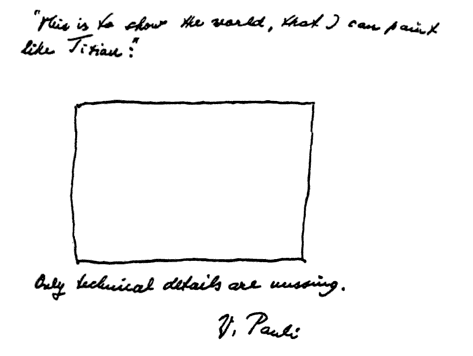
Although my category-fu is non-existent I could not help not remembering Pauli‘s response to Heisenberg’s claims that they (Pauli and Heisenberg) had found a unified theory but the technical details were missing:

This is to show the world that I can paint like Titian.

Pauli's Titian

Only technical details are missing

It will be really nice if this duality is formally proven for I had a hunch that a relationship existed, only I could not really determine it.

[Pauli’s painting from here]