sage-members has a very interesting thread on traceroute, including a presentation by Richard A. Steenbergen given at NANOG: “A Practical Guide to (Correctly) Troubleshooting with Traceroute” [pdf]
[Thanks gkoutep]

Fighting the automation paradox || Deployment θα κάνουμε φωνάζοντας "αέρα"
sage-members has a very interesting thread on traceroute, including a presentation by Richard A. Steenbergen given at NANOG: “A Practical Guide to (Correctly) Troubleshooting with Traceroute” [pdf]
[Thanks gkoutep]
From the RIPE DNS Lameness Statistics site:
The RIPE NCC runs a lameness check once a month on all DNS servers listed as delegation points within the RIPE NCC delegated zones. If a server fails this test, the test will be retried five times over a period of ten days, at varying times of day. If, after ten days, the server continues to fail the test, it is classed as lame.
Related document: RIPE-400
[via dns-wg]
Η ημέρα έχει 3 οχτάωρα. Σε ένα ιδανικό κόσμο αυτό θα σήμαινε πως μπορούμε να αφιερώσουμε:
Damn, agou is right!
Ιδιότροπος, περίεργος, ξεροκέφαλος, ακατανόητος μερικές φορές ακόμα και για τους παίχτες του. Και μετράμε: 2 συμμετοχές σε Euro, μία κατάκτηση against all odds και μία συμμετοχή σε Παγκόσμιο Κύπελο.
Όχι κι άσχημα για ένα “ξεμωραμένο μπάρμπα” όπως τον είχε αποκαλέσει ένα “διαμάντι” των αθλητικών μεταδόσεων.
Απλώστε πάλι τις γλώσσες σας, γιατί από τις τρύπες που έχετε κρυφτεί δεν φτάνουν.
(ref)
Thanks to Hacker News a book on Game Theory (with a political twist).
Not for the faint-hearted.
Disclaimer: I am not a Game Theorist, not even close.
Ένας καλός φίλος μου έστειλε χτες βράδυ με email ένα attachment:

Επειδή ο φίλος δεν μπορούσε να βρει κάποιον να του εξηγήσει πως βρέθηκε αυτό το name tag, ρώτησα τον ίδιο τον Ken Thompson και ιδού η απάντηση:
i dont remember exactly, but i think it was in the mid 80’s. i was invited by the government – department of science or technology or something like that. the occasion was at a time when the government was trying to require unix for sub contractors for standardization.
Ταυτόχρονα ρώτησα και τον Γιάννη Κοροβέση, έναν από τους πρωτεργάτες του Internet στην Ελλάδα:
Λοιπόν, ναι ήμουνα και παρών στο Ξενοδοχείο (Intercontinetal ?) γύρω στα 1989 μαζί με τον ΚΕΝ ήταν και ο B.Gopinath και ένας τρίτος που δεν θυμάμαι προς το παρόν.
Οργανωτής ήταν ο Γιάννης Κοζατσας του ΥΚ της ΓΓΕΤ του τότε (ΥΒΕΤ, Ε=Ερευνα)
Το πιο απλό γεγονός, μία απορία μπορεί να οδηγήσει σε κομάτια της Ελληνικής τεχνολογικής ιστορίας που είναι σχετικά άγνωστα.
Όποιος ξέρει / θυμάται περισσότερα για το γεγονός, παρακαλείται να σχολιάσει.
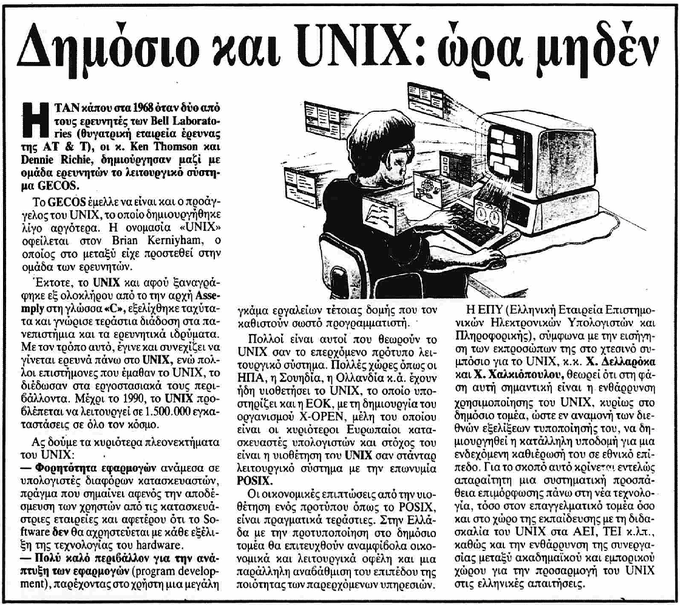
ΥΓ 2024/09/11 Στο twitter ποσταρίστηκε το σχετικό ρεπορτάζ από τον τότε τύπο:
When writing a sendmail.mc rule, you can use some operators on the left hand side, like $- (match exactly one token), $+ (match one or more tokens) and $* (match zero or more tokens). You may find yourself in a situation where for example you want to use a certain delivery agent for some of your users. Normally you would write something like the following:
LOCAL_CONFIG
Kmitsos btree -m -a.mitsos /etc/mail/mitsosusers

LOCAL_RULE_0
:
R$-  < @ $=w . > $*              $: $(mitsos $1 $)  $3
R$- . mitsos  $*     $#mitsos $: $1
The above example seems to be correct, right? But what if you have a user in mitsosusers that contains a dot (.) in the user name (for example yiorgos.adamopoulos)? Because the . is a token separator (see the OperatorChars definition in your sendmail.cf), $- will not match the name. So the correct ruleset in this case is:
R$+  < @ $=w . > $*              $: $(mitsos $1 $)  $3
R$+ . mitsos  $*     $#mitsos $: $1
I got bitten by this sometime ago, and that is why I am sharing it.
Although I am not a big fan of the NoSQL movement (mostly because many of its advocates use arguments I do not agree with) there are a few things that I like about the NoSQL crowd and I want to write them down*. Most of what follows stems from discussions through the years with our DBA and some friends who are members of the “Greek Database Mafia“.
For more than two decades the dominance of the relational model (even though no commercial system fully implemented it†) was undisputed. Nobody ever got fired for choosing a commercial RDBMS for an application, where instead one would look suspicious if one dared to propose something different. This situation is no different than what Rob Pike described in “Systems Software Research is Irrelevant” for Operating Systems:
You could say that databases outside academic research had come to a halt. You don’t believe me? Just ask Yannis Ioannidis who uses to say that “Databases are dead“‡ in the most emphatic way when he wants to stir things up in a conversation.
And this is what I like about the NoSQL crowd (== implementers, advocates and integrators) . They do not care about established standards. They are not afraid to experiment in a “real environment”. Some of them may focus on a single problem and solve it well. Others may aim at a wider range of problems. But no system is stopped from being developed and deployed because it not “SQL compilant” or not relational. And even though some of these solutions resemble CODASYLo, once again there is action in the field.
But please people, stop marketing them as a “one solution fits all”. For we will again end up in a stagnation era, just like when everyone was storing stuff in an RDBMS for lack and fear of better suited solutions. They do not invalidate relational systems. They fill in the gap left by them.
[*] – As I had promised.
[†] – By the way, did you know that GROUP BY works outside of the “relational box”?
[‡] – I have heard him say this while giving a speech.
[o] – “one usually gets a low-level record-at-a-time DBMS interface“, says Mike Stonebraker.
From page 25 of Connected:
A group of physicists who usually study waves on the surface of liquids were sufficiently intrigued that they decided to study a collection of filmed examples of La Ola in enormous soccer stadiums; they noticed that these waves usually rolled in a clockwise direction and consistently moved at a speed of “twenty seats per second”.*
Damn! I have participated numerous times in such waves and never, ever thought of that!
[*] – “Mexican waves in an excitable medium“, Nature 419, 131-132 (2002).
I am slightly disappointed. Two problems with the book (three if you count the translation which was forcing me to re-translate in English and back to Greek):
I wrote the above lines while reading the book and before the final chapter. Chapter 8 makes up for the above, but somehow I expected more. Maybe I do not belong to the target audience.
PS1: While reading the book, I think I discovered how the character of Ian Frost (from Turing) was named.
PS2: Going through the author’s page I came across stickK which seems to be a perfect tool to fight procrastination.