Autism’s False Prophets

I love “Cantor’s Dilemma“. In its final chapter (#22) a letter exchange between two powerful characters describes politics in Research in the most clear way. The book has one problem though. It is fiction.

Autism’s False Prophets” by Paul Offit is not. It covers the various vaccines-cause-autism theories and provides scientific data that prove them wrong. Do you want to read about bad science? It is there. Do you want to read about non-repeatable experiments? It is there. Do you want to read about how people mistake correlation for causation? There too! Do you want to find out how charlatans of any background take advantage of desperate people? Read the book. People want to be heard and want (instant) relief. With science not having the answers (or answers they can accept and deal with) charlatans step in loudly and fill the void. As is written in the book, hope is the best fix, better than any drug on the street.

“An easy-to-read medical thriller about the consequences of greed, hubris and intellectual sloppiness” reads the back of the book. This is a a chronicle and a science thriller, not a science fiction or science-in-fiction work. It contains the best explanation of the scientific method and the Null Hypothesis for the general public. Thanks to the book I now understand why the most illiterate and unscientific show ever presented on Greek TV exists:

“Unfortunately, the motivations of scientists who perform studies differ from those in the media who describe them: one wants to inform, the other to entertain.”

People want quick answers and are easy to jump to conspiracy theories that can provide them. It is no wonder that the opinion of journalists, ministers, politicians and celebrities that “attended the University of Google” gets accepted as expert opinion by the general public while the scientists are hiding “The Truth” by being on the payroll of big corporations. After reading the book I still do not understand why some people (the very same people that subscribe to such theories) do not visit their personal-injury lawyer every time they have a headache.

While if one is not directly involved with autism the book can have a few boring corners, it is a guide on how to present the facts. It is no wonder that the author gets so much hate mail and is the recipient of death threats.

PS: Two very interesting web sites that the book recommends are neurodiversity.com and
JunkScience.com.
30 χρόνια επιτυχίες

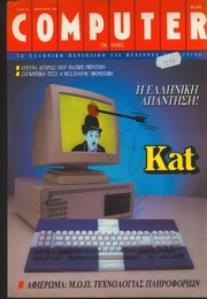
Kat was a Greek computer that dual-booted MS-DOS and Apple II

Ψάχνοντας για την ιστορία της Gigatronics και του Kat, έπεσα πάνω σε αυτό το PDF. Χρήσιμο ανάγνωσμα για όσους ενδιαφέρονται για την ανάπτυξη της Πληροφορικής στην Ελλάδα, τότε που ήμασταν παιδιά.

Μπενάλτι

* Ακολουθεί άσκηση επιστημονικής φαντασίας:

Οι διαιτητές κάνουν λάθη. Έχει όμως ενδιαφέρον να δει κανείς πως αντιδρούν προσπαθώντας να το διορθώσουν. Ο καλός ο διαιτητής θα το καταπιεί (μαζί με το βρισίδι της εξέδρας) και θα συνεχίσει τον αγώνα σα να μην έγινε το λάθος προσπαθώντας να είναι όσο πιο καλός μπορεί. Ο κακός ο διαιτητής, θα προσπαθήσει να βρει την ευκαιρία εκείνη που θα “ισοφαρίσει” το λάθος του. Θα προσπαθήσει να τη δημιουργήσει κιόλας. Δύο λάθη όμως δεν κάνουν ένα σωστό.

Για τους παραπάνω λόγους, ο καλός ο διαιτητής, επειδή ξέρει και μπάλα και τη δουλειά του, ξέρει πότε να διαμορφώσει ένα αποτέλεσμα χωρίς να γίνει αντιληπτός. Ο κακός ο διαιτητής, ακριβώς επειδή δεν ξέρει ούτε μπάλα, ούτε τη δουλειά του, δε μπορεί να κρύψει τις προθέσεις του. Το πιο καλό όμως με τον κακό το διαιτητή είναι πως δε χρειάζεται να τον ενημερώσει κανείς για το επιθυμητό αποτέλεσμα. Το εγγυάται αυτό η ικανότητά του.

decreasoner on OpenBSD

decreasoner is a Discrete Event Calculus reasoner written by Erik T. Mueller (author of “Commonsense Reasoning“). This is how I build it on OpenBSD 4.7:

  • tar zxf ply-3.3.tar.gz
  • tar zxf decreasoner.tar.gz
  • cd decreasoner/software/relsat-dist/
  • tar zxf ../../../relsat_2.02.tar
  • gmake -f Makefile.linux
  • cp ./relsat ../../solvers/
  • cd ../..
  • cp ../ply-3.3/ply/lex.py .
  • cp ../ply-3.3/ply/yacc.py .
  • decreasoner.py executes sort -g. Unfortunatelly, OpenBSD’s sort does not support a -g switch and you have to change it to -n. See also a discussion of sort -g vs sort -n.
  • ./make.sh

Someday I think I may contribute a script that may (semi)automate the above…

When should we migrate our mail servers to IPv6?

In “IPv6 and Email: What’s the Hurry?“, Todd Herr from Return Path argues:

As for migration strategies for email, I’m going to throw one out here that may run contrary to popular thinking: perhaps there’s no need for you to migrate your public facing email streams to IPv6 in the next few years. Instead, I propose that you slow down, focus on some other things first, and then worry about migrating.

A small conversation followed on twitter:

I cannot imagine anyone in the email delivery business risking not to be able to deliver email in the dual-stack world that we are entering. Really I am not crying wolf, for yesterday Daniel Karrenberg wrote:

So it looks like a genuine IPv4 network problem while IPv6 was just fine. A whole new level of redundancy!

Imagine having a path that reaches the desired destination and not taking it. Make no mistake, situations like this will start to appear. They will be routing problems, DNS problems and other unforeseen problems in the largest network interoperability experiment ever.

Todd Herr also advices that “First, you are going to have to listen for outbound email connections on IPv6 from your own customers”. I disagree with that also. The first step is to accept IPv6 traffic on all services before creating outgoing IPv6 traffic. This means that ISPs must be able to accept email coming from IPv6 before sending. And yes I know that while the robustness principle was invented for what one accepts and sends within a protocol’s specification (i.e. what one sends and accepts in an SMTP dialog) it also applies here. One cannot have machines ready to send via a medium where no one is listening. First we build the listeners and then the senders.

The time to deploy IPv6 is now: First the routers, then the servers, next the services and last the users. So yes, you do not have to migrate your email infrastructure to IPv6 tomorrow, but spend this year planning (and testing). In a year the migration clock will be ticking.

C interpreters

I spotted today on Hacker News an article about PicoC, a small C interpreter. This triggered my memory in a journey back in 1994 when I had asked over at comp.compilers whether any C interpreter existed. It was then that I learned about ICI, a cool C-like scripting language that deserves more attention, the Quincy C interpreter which evolved to an IDE, and Smac, the C-like
interpreter that comes embedded with the XCoral editor.

Then there are also CINT which is part of an even more interesting project, and of course Ch.

But the coolest interpreter that I’ve seen, is written by Diomidis Spinellis:

#include "/dev/tty"

It changed the rules for the IOCCC.

on Priority Inbox

After briefly reading about Gmail’s Priority Inbox, I think it is a product of what they are best at: classification. Using it though may change the “spaminess” of the messages in our inbox: Unimportant messages in our inbox are equally unimportant with spam messages, we just do not mark them as spam. A message can be both spam and unimportant, but not spam and important. Like @gtzi tweeted:

OH – “You are not in my priority inbox.”

Could it be that people stop periodically checking their “unimportant” email just like they do with their spam folders? Do we have before us yet another automatic Trash can? I do not know.

It is really cool to see message classification technology being used for something else than spam filtering though. I remember reading in sage-members about someone using a (Bayes based) spam filter to distinguish between normal (machine generated) mail sent to the system administrator which can easily be discarded and the rest (few) that needed the administrator’s attention.

Congratulations to Google. They always seek of new ways to classify and present data.

Update: Cool infographic on Priority Inbox: Gmail Evolution

Dune and eBook distribution idiocy

I like Dune. I like it a lot. So being the happy owner of a BeBook Mini, I decided to buy the 40th anniversary edition from eBooks.com. Unlucky me:

This book is only available to customers in the following countries: United States.

The same goes with other e-bookstores too. I am sure that there exists a perfectly standing reason in some legal universe that does not allow me to buy an eBook version of Dune because I live in Greece, while at the same time I can go to Eleftheroudakis, or Politia and buy the english version in paperback!

To make it even funnier, I can buy a Greek translation of Dune from e-bookshop.gr (which is what I did in the end). So if I live in Greece and cannot read the native language, I cannot buy the eBook version!

It seems to me that only O’Reilly, Apress and Manning “get” it about eBooks. The rest seem to try and reproduce their current business model in a new paperless medium. We’ve got news for you: An eBook is not a book. It is now time to understand that the book is the content and you’ve been selling the medium.

Upgrades: Friday or Sunday?

I think I’ve read about this on sage-members (it is also quite possible that I’ve blogged about it, but a quick search did not reveal anything):

You’ve got a major upgrade ahead of you, one that might take too long to complete and on top of that, the company (your employer) cannot halt while you are at the task. So do you schedule to start the upgrade on Friday evening, or on Sunday morning?

For years I used to opt for Friday evening. But it seems that I was lucky. For as I read in sage-members, what if the upgrade does not complete and you need support? Do you have (verified) support 24×7 for everything involved in the process, including hardware, software, personnel (if shifts are needed)? Even if you do, have you ever tested them? Are the support people you contact on weekends of the quality you expect or simply note takers so that you get an open ticket and a checklist while an actual solution may arrive on Monday evening? What if a simple fan fails and you need to replace it?

Start on Sunday mornings. As a bonus you get a full day for rest and mental preparation.

Unintended consequences

The recent sport related (but unsporting) events bring to mind the point I was trying to make in my previous post: That an organization must rely on its people following rules and processes and not on their display of filotimo (which must be saved for extreme circumstances only).

A decision was made to have the grass surface of the field in the Olympic Stadium of Athens replaced. The works begun and reports in the press showed progress. However, a pump was broken while the person responsible for it was on leave. This event went unnoticed until a friendly match was given between Panathinaikos and Genoa C.F.C. In this match, Djibril Cisse, Panathinaikos’ main fire power was injured. So were two players of Genoa. The pitch was declared unusable and will be replaced after the U2 concert in the Stadium (September 3).

Tomorrow AEK, who also use the Stadium as home, is supposed to play against Dundee United for the Europa League competition. Only now they face the problem of having to find a home stadium for the match to be played. In a controversial for some fans agreement, they decided to use the Nea Smyrni Stadium, home of Panionios FC. Angered by the agreement, Panionios’ fans entered the pitch and made it virtually unusable, not only for AEK, but for Panionios’ home game in Saturday too! Now AEK is supposed to defend its win, using Karaiskakis Stadium, Olympiacos‘ home, with no fans on their side- only fans of Dundee United who traveled from Scotland will watch the game.

A broken pump while a single person was on leave has lead to two damaged soccer fields and a team not having the support of their fans while giving an international competition game at home. This displays the complexity and inter-connectivity between systems in this world in weird and unforeseen ways, where the law of unintended consequence strikes, with a seemingly low priority glitch creating so much havoc because “the system” could not deal with (or even detect) it.