Ήταν λοιπόν που λες κάτι πουθενάδες, ο Χιώτης, ο Πουρσαϊτίδης, ο Μπίδης και κάτι άλλα παιδιά …
(ref)

Fighting the automation paradox || Deployment θα κάνουμε φωνάζοντας "αέρα"
Ήταν λοιπόν που λες κάτι πουθενάδες, ο Χιώτης, ο Πουρσαϊτίδης, ο Μπίδης και κάτι άλλα παιδιά …
(ref)

Stewart Brand of the famous “Information wants to be free” statement has actually commented in more detail:
Information wants to be free because it has become so cheap to distribute, copy, and recombine—too cheap to meter. It wants to be expensive because it can be immeasurably valuable to the recipient. That tension will not go away.
I revisited the above because of the recent Stratfor 2012 email leak. It represents the tension clearly: Stratfor sells expensive intelligence services (information), while in fact information once generated and stored (electronically) is bound to break free.
I was looking for the particular quote below today. With the help of Sakis and the Internet Archive, I located it. Martin Luther on books:
The multitude of books is a great evil. There is no limit to this fever for writing; every one must be an author; some out of vanity, to acquire celebrity and raise up a name, others for the sake of mere gain.

The man previously known for “the goal that never was” is now living his myth in Greece. And if someone takes the time to find out his life’s story, he deserves the myth.
Respect.
* I was at OAKA when I shot the photograph. I was thinking about the “Live your myth in Greece” slogan, and whether anyone in this country lives his myth. Roy does.
This was posted on CYBCOM by Bernard Scott:
We are but whirlpools in a river of ever-flowing water. We are not stuff that abides, but patterns that perpetuate themselves.…We are swimming upstream against a great torrent of disorganization….In this, our main obligation is to establish arbitrary enclaves of order and system….It is the greatest possible victory to be, to continue to be, and to have been. No defeat can deprive us of the success of having existed for some moment of time in a universe that seems indifferent to us.
This is no defeatism….The declaration of our own nature and the attempt to build up an enclave of organization in the face of nature’s overwhelming tendency to disorder is an insolence against the gods and the iron necessity that they impose. Here lies tragedy, but here lies glory too.
A couple of days ago the enet.gr domain went missing. I observed this because of a call I got from our press office where a user complained that sending mail to journalists was not possible: “I can email all the world, except journalists”. The mail logs showed that:
Feb 17 13:08:26 ns sm-mta[1215]: q1HB5o4Y001215:
lost input channel from host.name [x.x.x.x] to mta after rcpt
So what was wrong? Because of delays in DNS server responses regarding enet.gr, Thunderbird timed out and dropped the connection (the problem appeared to be Thunderbird specific). My quick hack of the moment because I was on the road was to point enet.gr to 127.0.0.1 in the SMTP server’s /etc/hosts (I was on the road with limited connectivity). A far better solution is to increase the value of mailnews.tcptimeout preference.
“The Cybernetic State” is a book written by Javier Livas and is available as PDF on request from the author. From the preface:
The emergence of a cybernetic State is now a real possibility, and most likely inevitable in the near future. This book sketches this information age organization and the cybernetic management principles on which it is based. As we shall see, many of its features are already present in embrionary form in the modern democratic State.
The description of the cybernetic State relies on the Viable System Model (VSM) developed by professor Stafford Beer and explained in several of his books. This model originates from control theory and the cybernetics of the human nervous system, and has been adopted and validated by management science. In this book the VSM is used to show the nature of the State.
The enormous explanatory power of this cybernetic map will show that Economics, Law, and Political Science, which have mostly been studied separately, actually refer to three different aspects of the same phenomena, namely the State. In this sense, the book attempts a synthesis of ideas that were born disconnected and remained so for a long time. Helpful insights about the evolution of economic, legal and political theory are a byproduct.
[via CYBCOM]
The first book I ever bought from ISACA‘s bookstore, was Nigrini‘s book on Benford’s Law. Briefly stated the law says that in a series of numbers that occur while observing a phenomenon, numbers starting with 1 are more likely to occur than those starting with 2 which in turn are more likely to appear than those that start with 3 and so on up to numbers starting with 9.
The law stands for other bases too.
I’ve had discussions about Benford’s Law applicability on email data over at twitter with Martijn Grooten, but never run any tests. A few hours back I had an interesting discussion with Theodore which reminded me of the law and so I decided to see whether it stands on a number series related to email. The easiest test I could run was on the length of the Subject: lines. Bellow what follows is a graph of Benford’s distribution and actual data from 376916 mails that passed a certain mail server during last week:

It seems that the length of subject lines follow the pattern. For the sake of speed I have omitted from the computation non-latin subject lines, which means that I have to recompute whenever I find a timeslot longer than 15 minutes. But then again if I am to find such a slot, I think I will try to see whether the message body size also follows a Benfordian distribution. It may be more difficult to verify though because of different mail servers imposing different limits on the size of messages sent and received by them. Oh wait, Sotiris just did that! The rest of the tests mentioned in Nigrini’s book are also worth a try.
So what do your logs say about subject lines’ length and Benford’s Law? Do they follow the pattern? I’d be glad to see your answer in the comments section.
PS: I see that there is now a second edition of Nigrini’s book about to be published!
According to this leak:
Russia alleged that an arms control race was unfolding in cyberspace and that constraints on state capabilities were necessary
Now where had I heard that before? It was in 2009 while watching a presentation given by iDefense’s Eli Jellenc. In it he presented the following variation of the Prisoner’s Dilemma:
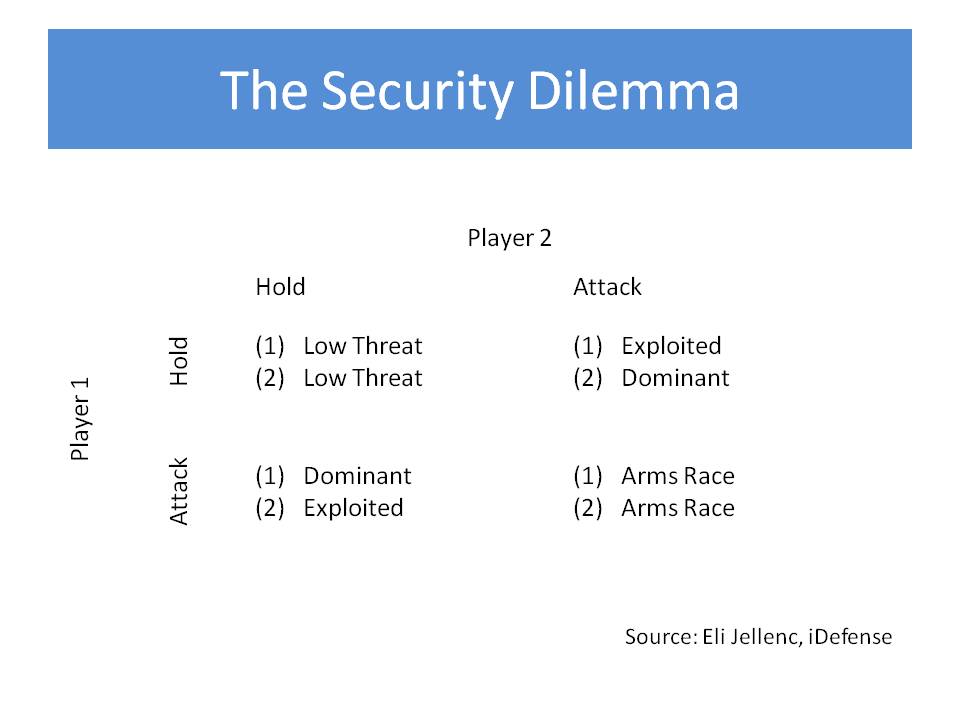
The basic premise of the model is that efforts to increase your own security makes others insecure. In Cyber warfare it is easier to attack than to defend a complex system (or at least it feels that way since time is on the side of the persisent, patient attacker). It is also very difficult at times to distinguish between offense and defense and the fact of the matter is that both the digital underground and the private sector have well established offensive capabilities for hire. The result of the situation is that everybody is forced to deploy offensive capabilies with a spiral of mistrust being built at the same time as a side effect.
Indeed an example of why such a spiral of death is formed is given in “Strategy and the Revolution of Military Afairs: From Theory to Policy“:
“Why, foreign leaders ask, would the world’s only superpower seek radical improvement of its armed forces in the absence of a clear threat? Given the expense of accumulating national power, some may assume it is meant to be used and conclude that the United States is improving its military capabilities in order to impose its will on others. The United States can either accept such suspicions or find a new, less intimidating method of pursuing the revolution in military affairs, perhaps through greater cooperation with potential allies. The problem is that such cooperation could speed the dissemination of new technology, techniques, and ideas, and thus contribute to the emergence of challengers. But if the United States unilaterally pursues the RMA, other states will respond, whether symmetrically or asymmetrically. In turn, knowing the benign intentions of the United States, American leaders and planners will consider this threatening. Why, they will ask, would other states seek to improve their military capability unless contemplating aggression? Vigorous American pursuit of the RMA may make other nations feel less secure and their response will make the United States feel less secure. The result may be a spiral of mutual misperception and a new arms race, albeit a qualitative rather than quantitative one.”
Ironic how I was scolded in a meeting a couple of months ago for mentioning Game Theroy as a tool to study strategies (“Theory is one thing, reality is another”) when in fact we see how such simple models are suited to study reality.
But what do I know dear officer? In his “How cyberattacks threaten real-world peace” TEDxParis talk (a quick summary of which you can read here), Guy-Philippe Goldstein presented the following 1978 model by Rober Jervis in “Cooperation under the security dilemma“:
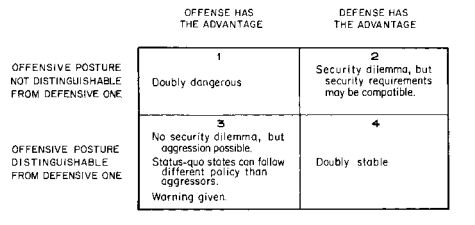
As Jervis puts it:
“The fear of being exploited is what drives the security dilemma”
Game Theory and the Cyber Domain? What do I know. I simply read about stuff.
Further reading:
Now I am off to read “Security and Game Theory” thanks to Sakis.

 Managing organized complexity