You are a writer (so start acting like one)

I got You are a writer by Jeff Goins on a day it was given for free years ago. I got to read it over the weekend. I thought then, and I still do no now, that the book offers advice to people who write code too. Maybe because sometimes I believe that code is like a poem. So I will try to rehash advice I found useful here, since this seems to be one of the acceptable self-help books that have come my way.

While anyone can connect with anyone and put stuff out there, how does one gets noticed? By helping people. By relieving their pain. I’ve advocated answering one question per day on ServerFault (or StackOverflow, or whatever clicks to you), although I do not always practice this. I used to, though, years ago when mailing lists and newsgroups were the thing.

You need to build a platform. This blog is a platform. I post stuff here. Others do it with more success, for example John Sonmez who uses a variety of platforms (blog, YouTube channel, podcast, book) to publish his work (and he gives 90% of his work for free he said on Ruby Rogues). You make the platform and you establish a brand. Without a brand you are forgettable.

And you know what helps you not being forgotten? Networking does. Meaningful relationships do. Relationships that are mutual, matter to both parties and give you the opportunity to make friends and find mentors.

But nothing of the above makes any sense unless you are prepared to answer the following questions:

  • Am I serious?
  • Am I committed?
  • Am I prepared to be challenged?

Please take the time to sincerely answer these questions. And while you are at it, understand that you probably are not the best coder in the world yet. But you can become one. There is room at the top here.

Like one of the main characters in The Phoenix Project said, mastery comes through practice. And here Goins argues that the best kind of practice is done publicly. Interestingly GiHub seems to be our public place of practice.

While you’re at it, learn to estimate. Underpromise and overdeliver. Especially when you are part of a team. Like Goins writes, you have a gift. Someone is willing to work with you.

Go on! Practice.

The Phoenix Project

I remember I got the Phoenix Project for the Kindle for free on a promotional day sometime back in 2013. I’ve been meaning to read it ever since. But back in those days I was suffering from the problems that the main character is suffering for at least the first 35% of the book. And well, when you can simply rename the characters of a book and relive the experience it is not something that helps.

I finally made it this week and got through it with some late night reading. Just like now that I am writing the post minutes after reading the last page. I am not going to rumble about the three ways or even the four types of work. By now this is common stuff and even some years ago, if you tried to read about Systems Thinking or even Cybernetics, you would have reached to those conclusions. But hey a story always imprints a lesson better than a textbook and this is so much better than The Deadline. You want to revisit The Deadline in order to copy the notes of Mr. Tompkins. You do not need to revisit The Phoenix Project.

Interestingly the book forms a career path for people interested to follow. It kind of reminded me of Putt’s Law and how you cannot postpone your promotions forever. I find it kind of optimistic careerwise, depending the location of the reader and there is still the question of the top floor.

While this is a novel about DevOps, DevOps still means different things to different people. Luckily this is a novel for all people for whom DevOps at least means something.

Start me Up!

I cannot even remember how many disks Windows 95 was, fourteen, fifteen? Something like that. And how many hours installing it to machines around the lab.

That was the day I said goodbye to FTP software’s PC/TCP and Trumpet Winsock.

Speed of Dark

“If they aren’t going to listen, why should I talk?”

I learned about Speed of Dark from Katrina Owen on Ruby Rogues. The hero is an adult autistic in the near future who is working at a pharmaceutical company doing applied mathematics.

Most of the book is narrated in first person with shivering accuracy I might say. I never knew about Elizabeth Moon so midway I looked her up; she is a mother of an autistic. And the efforts to understand her son show. A true advocate for autistics, adult or not. And great parenting advice.

I really cannot write much about the book without giving away the plot, but it is all there: autistic education, effort to fit in, bullying, sportsmanship, search for love, search for meaning, tough choices. A really fascinating book and a touching story. And lots of music. With detail. And I keep thinking that I started the book while I paused Birth of a Theorem at a chapter full of music in order to reread it.

Speed of Dark will affect you regardless of whether you know of autistic people or not. It is one of those books that make you a better person.

This won’t take long

(only your weekend)

After numerous installs since the Windows 3.11 era I should have known better and not tried the upgrade from Windows 7 to 10. But I do not have a spare machine for a clean install and therefore when the popup assured me that I could upgrade the laptop, I broke my rule:

You never change (upgrade or downgrade) the operating system that came with your laptop. If you do, at least make sure you have a spare machine to do actual work.

That is because laptops come with hardware that is not necessarily recognised by anything else other than drivers supplied by the manufacturer. So if you do change the OS, or even install a “clean” version of it (without all the bloatware that manufacturers package with it) be prepared for stuff not working. Yes, that fingerprint sensor, that 3G modem, the winmodem in the old days and before the linuxant drivers for example.

So anyway I felt brave and went along and tried it. It seemed to go fine. But at 76% the process stalled. And then it failed with DRIVER_POWER_STATE_FAILURE. Following the suggestion of a friend, I tried the online downloading tool that Microsoft gives to download and / or start the upgrade. It failed to even start. I run it again and built an ISO DVD to have around just in case. But still I was facing the same problem.

I gave it some thought after browsing the Net for a bit and thought that it could be the speed setting switch which I almost always have set to “stamina” and not “speed”. Again at 76% the procedure stalled like forever. I shut down the machine and when I powered it up again the procedure continued. And finished. Yes!

So I browsed around to get a feeling of the system. And then Skype was not working. Fair I thought since my login account was not linked to a Hotmail.com account and maybe after the upgrade this is a mandatory requirement. In the mean time OneDrive installed and update. So let’s reboot and see what happens. And it never rebooted. It stuck on the Windows 10 logo with the balls doing their circles.

So I shut down the machine again. I power it on and it is OK. I backup my data, shut down the VAIO and press the magic “assist” button. Windows 7 with all the bloat that Sony has chosen gets installed on the machine again. About 1h later I start uninstalling stuff. Adobe, McAfee, Office (Trial), SQL Server, Norton go by. SP1 gets installed. 214 updates after SP1 too.

Like the upgrade procedure said: This won’t take long

SysAdmin Day today!

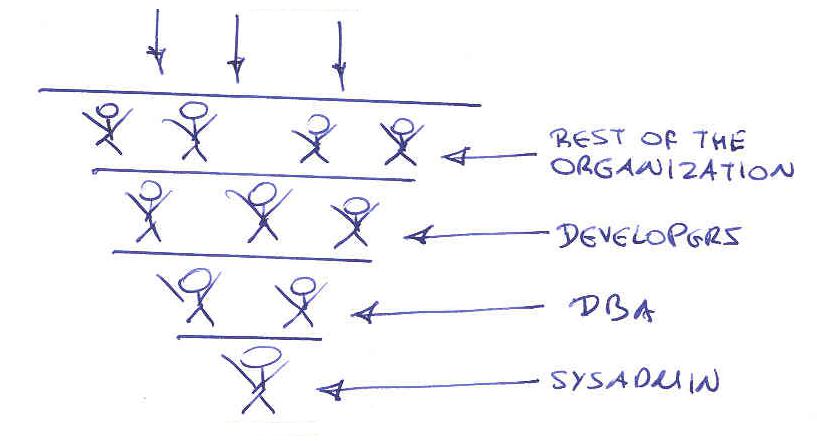
A day in the life of your sysadmin

Well it is SysAdmin Day today and there will be lots of cheerful happy posts of appreciation. But me, I will be a fun spoiler today and will point you to the most powerful posts that I’ve read this year:

There’s a reason we have these days and it is not necessarily light or funny.

And one more essay for fun and thought.

The Varouhacker

[ Update: Well it is true: Varoufakis OMFIF briefing. ]

I will suspend my belief for a while and will assume that half of this plan is partially true. With regards to hacking his own ministry in order to get data we see that:

[The plan] would allow the creation of a parallel system that could operate if banks were forced to close and which would allow payments to be made between third parties and the state and could eventually lead to the creation of a parallel banking system

I strongly believe that if true, then Varoufakis has read the “Flash Boys” where a bunch of guys set out and created a fair stock market platform. But you know, Flash Boys writes nothing about the implementation details of this. They are left out because they would make the story boring (and would genuinely interest less than 10% of the readers). Which means he cannot even begin to understand the pain of building anything close to this, let alone the effort to direct user support.

The man may be able to capture an audience but understands nothing about implementation.

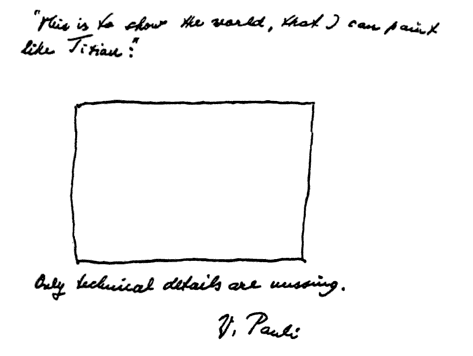
Wolfgang Pauli: This is to prove that I can paint like Titian. Only the technical details are missing
Wolfgang Pauli: This is to show the world that I can paint like Titian. Only the technical details are missing

But here is another thing:

“You know what? I control the machines, I control the hardware but I do not control the software. The software belongs to the troika controlled General Secretary of Public Revenues. What do I do?”

Whether you read this as having legitimate or illegitimate access to the system (the article is poorly written on this and implies at first that the systems were hacked and they gained control, but the second time it mentions hardware control it reads as legitimate access) I take it that nobody around Varoufakis knew anything about Oracle.

I also take it that Varoufakis and OPSEC are a recipe for disaster.

At the risk of being pedantic I find this to be very poor reporting because of a detail: I can never understand whether said control of the systems was legitimate or a result of the hack; neither V’s words nor the reporter’s make it clear whether unauthorised access has been committed. This is a crucial detail for me. It makes the difference between having people prosecuted or not. However by making the assumption of who the Columbia technologist is, this is legitimate access to the systems, hence no hack.

My SICP story

A cousin from downunder is visiting these days, so I want to talk about a gift he once gave me.

20+ years ago I had to pass a course named “Programming Languages”. One of the languages to learn was Lisp and for that the professor handed us all a copy of David Betz’s XLISP for DOS (he later focused only on XScheme and even later XLISPs by Betz are Schemes). However I did not have a PC at the time and when I told my Professor that he did two things: First he gave me a copy from the library of Structure and Interpretation of Computer Programs (because we had MIT-Scheme at the lab). Second I gave the test in Scheme instead of Lisp.

After a while I had to return the copy of SICP at the library. But the book grew on me. I could not find it at the local bookstores and Amazon was not even a glimpse in Bezos’s mind (and even if it was, I could not have a credit card at the time thanks to how our banking system worked, but that is another story). So what my father does is he sends a letter to my cousin with the book title (bad phone lines and bad pronunciation were not helping) and I think three months later the CS book that mostly shaped my thought arrived!

Thank you George for the wonderful present!

PS: Some years later, in 1996 the second edition came out. That I bought from MIT Press directly via email along with a T-shirt of the book.