
Any book where Elric uses the Stormbringer is interesting enough.
Tag: Books
Game of Thrones – Book 1
I enjoyed reading the book. That much is true. After all I seek maps of Westeros and Essos and am waiting for the G.R.R. Martin sanctioned ones. I have to note though that once you’ve read LotR, Dune and Iliad it seems that you’ve read almost all epic stories. Break for one week before I proceed to Book 2.
A nagging note: I find it funny that Amazon sells the novels for ~ $10 and Greek bookstores for ~ €24.
(Book 2)
Where Wizards Stay Up Late
A lot of us think that they know fragments of the birth of the Internet. Most of these fragments we cannot put in the proper chronological order, nor are they always accurate (with the most notable example that the Internet was invented as part of the US nuclear defense).
If you make even a penny from the Net you must read the book. You will learn a lot about the “founding fathers” (even if many of them disagree on who is the elder one) their dreams and the bottom up emergence of TCP/IP and the Net (in contrast with the top down push for the OSI protocols). Learn the history (and pre-history) of the medium until the early 90s. You have to.
April 4th, 1984
To mark the paper was the decisive act. In small clumsy letters he wrote:
April 4th, 1984.
[1984]
Spot the reference (resurrected)
I was looking for the particular quote below today. With the help of Sakis and the Internet Archive, I located it. Martin Luther on books:
The multitude of books is a great evil. There is no limit to this fever for writing; every one must be an author; some out of vanity, to acquire celebrity and raise up a name, others for the sake of mere gain.
The Cybernetic State
“The Cybernetic State” is a book written by Javier Livas and is available as PDF on request from the author. From the preface:
The emergence of a cybernetic State is now a real possibility, and most likely inevitable in the near future. This book sketches this information age organization and the cybernetic management principles on which it is based. As we shall see, many of its features are already present in embrionary form in the modern democratic State.
The description of the cybernetic State relies on the Viable System Model (VSM) developed by professor Stafford Beer and explained in several of his books. This model originates from control theory and the cybernetics of the human nervous system, and has been adopted and validated by management science. In this book the VSM is used to show the nature of the State.
The enormous explanatory power of this cybernetic map will show that Economics, Law, and Political Science, which have mostly been studied separately, actually refer to three different aspects of the same phenomena, namely the State. In this sense, the book attempts a synthesis of ideas that were born disconnected and remained so for a long time. Helpful insights about the evolution of economic, legal and political theory are a byproduct.
[via CYBCOM]
The five most important questions
It was thanks to this post by John D. Cook on abandoning projects that I got interested in Peter Drucker. So I went to ebooks.com and looked up whether there exist any ebook versions of his works. I bumped into “The Five Most Important Questions You Will Ever Ask About Your Organization” which is focused on non-profit and social organizations. Being a public sector worker, the book seemed a natural candidate.
The book expands on an earlier 1992 version written by Drucker and contains essays by him and other experts in the field of management. All essays are centered around five basic questions which as Drucker writes it is important to ask:
“The most important aspect of the Self-Assessment Tool is the questions it poses. Answers are important; you need answers because you need action. But the most important thing is to ask these questions.”
The five questions are:
- What is Our Mission?
- Who is Our Customer?
- What Does the Customer Value?
- What Are Our Results?
- What Is Our Plan?
Non-profit organizations are about changing lives and these questions are a tool to achieve this. Even without reading the explanatory essays their importance is evident (as is answering them in a sincere way). And while the book itself is not a self-assessment tool for an individual, the questions themselves are a good start.
It is beyond evident to people that know me that the concept of organized abandonment is what I liked most in the book. I’ve been (unsuccessfully) advocating a similar stance within my employer’s organization for years but I had never seen it so clearly articulated until now. Plus this time it is not only me saying this, Drucker said that too, see? IMVHO, organized abandonment is the basic evolution mechanism for organizations (public and private sector).
This is definitely a book I will revisit in six months time. To evaluate its impact on my way of thinking within my own organization and to see whether I managed to pass anything along.
PS: I bought the PDF version of the book by mistake. Normally I try to read ePub versions on my BeBook Mini, but luckily in this case the BeBook rendered the PDF adequately.
A vision so noble
Vasilis Katos at the 1st Athens Chapter ISACA Conference argued that we do not need cyber security experts, rather we need champions on the multitude of the different and complex areas that this domain encloses. He is not alone in believing this about experts. With the domain being new, hot and with commitment from Governments for financial backing of projects, the landscape is open for expertship claim. And since we are at the infant stages, many try to establish themselves as the strategists who set the pace, no matter how disconnected from reality they may be.
Whenever a new domain is introduced, until it is sufficiently comprehended people try to use analogies to make the connection. It is a no brainer then that since anything colored “cyber” starts to get a military approach, analogies with highly successful strategists of the past and relevant studies of them will appear. Think of it: Sun Tzu seems to fit every subject, from the battle ground, to sports, to (non military) management. I’ve seen efforts for both Sun Tzu (although far from a complete treatment) and Clausewitz and I am sure that others exist too. It is no wonder then that John Boyd and his OODA Loop would receive treatment too.
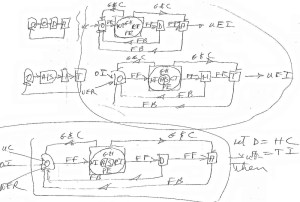
Since I found the OODA Loop concept interesting I set out to learn a bit more about it. This is not an easy task for a civilian for Boyd did not really leave much written work behind with the exception of a continually refined set of slides that when finalized took about 15 hours to present. To understand the loop, I read “A vision so noble” by Dan Ford. It’s chapter 2 contains a longer explanation of the OODA Loop than Wikipedia does and even includes a hand written sketch of it:
For a more understandable version of the loop see the Wikipedia drawing and article.
Boyd is mostly an attacker and not a defender and indeed one can find cyber similarites in his work, where in page 40 Ford uncovered from his boxes:
Infiltration
* Blitz and guerrillas infiltrate a nation or regime at all levels to soften and shatter the moral fiber of the political, economic and social structure. To carry out this program, a la Sun Tzu, Blitz and Guerrillas:* Probe and test adversary to unmask strenghts, weaknesses, maneuvers and intentions.
* Shape adversary’s perception of the world to manipulate or undermine his plans and actions.
Purpose
* To force capitulations when combined with external political, economic and military pressures.or
* To minimize the resistance of a weakened foe for the military blows to follow.
Do not all the above match Cyber Warfare aims? So there exists value in studying Boyd and his tactics, but not a one-to-one mapping as many would hope that would make the transition to a cyber domain easier. The OODA Loop is there, one has to understand that it is not completely linear (OODA means Observation, Orientation, Decision, Action but you are constantly in an observation state that provides feedback) and is valuable.
Boyd believed that People not weapons win wars. Not very far from the observation that a good friend has made that people and not machines get hacked or my belief that people are the actual cyber weapons.
A good 70 page book based on Ford’s MSc Thesis that definitely helps expand our thoughts on the matter.
Off to read “The Dynamic OODA Loop: Amalgamating Boyd’s OODA Loop and the Cybernetic Approach to Command and Control” now.
PS1: An earlier version of Ford’s book seems to be available on Lulu as PDF.
PS2: Boyd on management
Nerves
Shortly after the Fukushima accident Curt Monash tweeted:
Lester del Rey anticipated #Fukushima-like nuclear reactor crisis, nurse practioners, & some feminism, all in a great 1942 novella Nerves.
Note that Monash made a typo: It is a 1952 novel. Even though it is DRM “protected” I bought Nerves for €4.12. It is a science fiction thriller that takes place in an atomic plant during an accident.Sometimes it tired me while trying to explain science that had to be believable and yet so close to our timeline. The book however does contain useful managerial advice on extreme crisis management (and how to motivate your stuff to perform the impossible) and one of the best definitions of insanity:
He had lived in an impossible world where only absolute perfection counted, and where he refused to accept perfection as possible, even to himself! He had built his hate against the impossible into a constant churning force that whipped every tissue of him during all his life.
As a book it felt more like a late draft, somewhat unfinished.
Figure it out…
“Figure it out, Cliff, and you’ll amaze everyone”, Dave said.
Or, how a $0.75 imbalance can markedly change your life.
The Cuckoo’s Egg, page 5
 Managing organized complexity
