For files larger than diff(1) can handle there exists diffh.c from Bell Labs (and has been around since the PDP-11 days). But even diffh is not always good enough. So why not use idiffh which works on any system with a C compiler and knows of no limits in file sizes and strings?
I first learned about Wolfram’s “A New Kind of Science” while reading Chaitin’s “Meta Math! The Quest for Omega“. And from there is all that I know about NKS, for its volume is prohibiting for my spare time. However, for anyone interested, NKS is available online and there’s an iPad version too.
When you get an ORA-24550, it might be because there’s a NULL returned from a SELECT statement that your code is not handling properly (like a string pointer equal to NULL instead of pointing to “”).
Στο CAS αναμένεται να προσφύγει ο Ολυμπιακός επικαλούμενος αντικανονική συμμετοχή του Νίκου Ζήση στον 4ο αγώνα της σειράς πρόκρισης στο Final Four της Ευρωλίγκας. Υπενθυμίζεται πως ο Ολυμπιακός έχασε 88-76 στον αγώνα αυτό.
“Next month another block is placed atop the previous one. Then comes along an historian who asks, ‘Well, who built the cathedral?’ Peter added some stones here, and Paul added a few more. If you are not careful you can con yourself into believing that you did the most important part. But the reality is that each contribution has to follow onto previous work. Everything is tied to everything else.” –Paul Baran
My review on “Algorithms on strings” (for which I’ve blogged before) for the ACM SIGACT News is out. There’s a typographical error though: I did not review “Algorithms on strings” by Dan Gusfield, but “Algorithms on strings” by Crochemore, Hancart and Lecroq.
It seems that this co-relational model tries to answer my favorite question directed to NoSQLers: “Where is the math?” It does so by using category theory. However:
“Obviously, the precise formalization of SQL and noSQL as categories is outside the scope of this article”
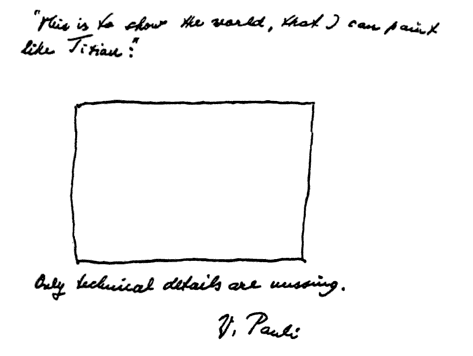
Although my category-fu is non-existent I could not help not remembering Pauli‘s response to Heisenberg’s claims that they (Pauli and Heisenberg) had found a unified theory but the technical details were missing:
This is to show the world that I can paint like Titian.
Pauli's Titian
Only technical details are missing
It will be really nice if this duality is formally proven for I had a hunch that a relationship existed, only I could not really determine it.
This is the title of the presentation that I gave yesterday at the Greek OWASP Chapter meeting which was held at the CoLab. The presentation is based on my experiences in participating in three Cyberdefense exercises and can basically be summarized by the following points:
Cyberdefense exercises are not a competition. We do not participate to “win”. In fact if there’s any win-lose objective it is a success that we lose. From loss we can learn; a lot.
Given that there are no actual attacks taking place during the exercises, communication is what we exercise on.
Cyberdefense exercises are about team formation. Team formation of organizations and individuals who up to now were not particularly interested in cooperating, since besides being critical infrastructures no other common ground exists between them.
According to Tuckman, group development has four stages: forming, storming, norming and performing.
Due to the fact that with each exercise the number of participants increases, we iterate a lot between forming and storming.
Parkinson’s Law emerges a lot during storming. Cyberdefense is an enormous complex beast, difficult to grasp, but there exist in it tiny bits for everyone to understand well enough to consider them most important (even from the whole picture).
Building a web of trust among people is the key to everything. Cyberdefense exercises help in developing trust because they bring people together.
While organizing Cyberdefense (and understanding Cyberoffense) the following model from Best and Luckenbill must be in our minds:
Form of Organization
Mutual Association
Mutual Participation
Division of Labor
Extended Organization
Loners
no
no
no
no
Colleagues
yes
no
no
no
Peers
yes
yes
no
no
Mobs
yes
yes
yes
no
Formal Organizations
yes
yes
yes
yes
Many thanks to @kpapapan for inviting me to give the talk and to the audience for bearing with my rants.


 Managing organized complexity