
Ελληναράδικη Οδήγηση
Σχολιασμός αυτού του αυθεντικού στυλ οδήγησης από τον GreekDriver.
The bat book, 4th edition
I just bought a PDF version of the fourth edition of the “bat book“. At 1310 pages, it makes sense. Plus I get to carry it around with my laptop.
face-off
Για να δούμε τι θέλει να μάθει η foteinoula:
- Όνομα: Γιώργος
- Γεννέθλια: 4 Μαρτίου
- Ζώδιο: Ιχθείς;
- Χρώμα ματιών: Καφέ;
- Χρώμα μαλλιών: Καφέ με άσπρες τρίχες;
- Έχεις ερωτευθεί ποτέ; ΝΑΙ
- Μουσική που ακούς: Jazz και ότι καλό έβγαλε η Death Row μέχρι το 1997
- Χαρακτήρας Disney: Ο Ήτα-Βήτα, ο Φάντομ Ντακ και ο Γλόμπος
- Ποιος φίλος / φίλη μένει πιο μακριά; Ο Δημήτρης
- Πρώτο πράγμα που σκέφτεσαι όταν ξυπνήσεις: Τι ώρα είναι;
- Κάτι που έχεις πάντα μαζί σου και δεν αποχωρίζεσαι: [it does not compute]
- Τι έχεις στον τοίχο σου: Μια αφίσα του John Coltrane
- Τι έχεις κάτω από το κρεβάτι σου: Ξύλινο πάτωμα
- Αν ήσουν μόνος/η στο σπίτι και άκουγες ένα βάζο να σπάει τί θα έκανες: Θα το μάζευα
- Αγαπημένος αριθμός: 96
- Αγαπημένο όνομα: Ειρήνη
- Χόμπι: Ο Ολυμπιακός
- Πού θα ήθελες να ήσουν τώρα: Στο κρεβάτι για ύπνο
- Μία ευχή για το μέλλον: Ανοχή στη βλακεία
- Αν μπορούσες να ταξιδέψεις στον χρόνο και να γυρίσεις πίσω, σε ποιά εποχή θα πήγαινες: Στο μεσοπόλεμο, για να δω από κοντά το άλμα στην ανάπτυξη της Φυσικής
- Φωτιά! Πάρε κάτι μαζί σου: Τη γυναίκα μου και τον adamo v2.0
- Αγαπημένο λουλούδι: Κανένα
- Αγαπημένη σειρά: Διαστημόπλοιο Αργώ
- Αγαπημένη ταινία: The Empire Strikes Back
- Αγαπημένο τραγούδι: Hurricane 2000
- Αγαπημένο βιβλίο: [it does not compute]
- Αγαπημένο ρούχο: Κανένα
- Αγαπημένος καλλιτέχνης: Coltrane
- Αγαπημένο φαγητό: Σπαγγέτι
- Με ποιόν χαρακτήρα καρτούν ταυτίζεσαι: Με το κογιότ
- Κακή συνήθεια: Νεύρα
- Χαρακτηριστικό της προσωπικότητάς σου που σου αρέσει: [it does not compute]
- Χαρακτηριστικό της προσωπικότητάς σου που δεν σου αρέσει: Νεύρα
- Συνηθισμένη ατάκα: Ουστ ρε!
- Δουλειά που θα ήθελες να κάνεις: Αυτή που κάνω, με καλύτερες συνθήκες όμως
- Μεγαλύτερος φόβος: Είναι προφανής
- Πιστεύεις ότι τα κατοικίδια είναι: Χαρά για κάποιους, εφιάλτης για άλλους
The game stops here.
Scott Yanoff’s internet services list
This is a question that I asked during my presentation at the GBC08:
finger yanoff@alumni.cs.uwm.edu
How many people remember what this is?
The GBC experience
I just returned from the GBC 2008. Great fun and interesting stuff. Highly reinvigorating when you are in the midst of a lot of things. Some observations:
- Matt Mullenweg rules!
- So does Boris Veldhuijzen van Zanten, who by the way gave the most interesting presentation (Boris, Patrick thanks for the beers).
- After all these years I finally met in person MarkP and GeorgeP. It is a pitty that we did not have much time to catch up. We will catch up next year.
There must be rivers of beer on Ios island…
Tribute to Honor Jim Gray
From DBWorld:
Tribute to Honor Jim Gray
May 31, 2008 @ UC Berkeleyhttp://www.eecs.berkeley.edu/IPRO/JimGrayTribute
Jim Gray’s family, friends and colleagues have arranged a public day of talks and reminiscences in his honor, to be held on May 31, 2008, at UC Berkeley. All are welcome.
Although Dr. Gray will be officially listed as missing until 2012, his family has asked that we have this Tribute now, to honor him before too much time has passed.
There are two parts to the Tribute. The General Session that begins the day is intended for the general public. The Technical Sessions will go through the afternoon, and are intended for a computer science audience. The organizers request that people wishing to attend the Technical Sessions register in advance on the web, to facilitate planning.
More information, including the program for the day, registration forms, and information on accommodations is available on the web at http://www.eecs.berkeley.edu/IPRO/JimGrayTribute. Questions about event logistics may be directed to jimgraytribute@eecs.berkeley.edu .
The search for Dr. Gray is detailed in Wired Magazine’s article: http://www.wired.com/techbiz/people/magazine/15-08/ff_jimgray
[via DBWorld @ 2007/12/4]
Η Java δεν είναι C…
– Στη Java πατάς την τελεία (.) και σου βγαίνουν οι επιλογές. Δεν είναι σαν τη C που πρέπει να τα γράφεις όλα με το χέρι.
Δεν κατακρίνω αυτόν που το είπε. Αυτοί που τον έμαθαν να σκέφτεται έτσι πρέπει να βρούν τρύπα να κρυφτούν.
The Power of 10: Rules for Developing Safety-Critical Code
Ο Gerard J. Holzmann του NASA/JPL δίνει 10 κανόνες, εύκολους να τους θυμάται κανείς, για τη συγγραφή safety critical code. Παρόλαυτά είναι καλό να τους θυμόμαστε και όταν γράφουμε “κανονικό” κώδικα. Κυρίως γιατί σε αντίθεση με άλλα standard, δεν είναι σελίδες επί σελίδων, άρα μπορούμε να τους θυμόμαστε εύκολα και δεν φτάνουν να κυβερνάνε ακόμα και την αισθητική του κώδικά μας (ή ακόμα και το πόσα “spaces” είναι το [TAB]). Οι 10 κανόνες είναι:
Adhering to a set of 10 verifiable coding rules can make the analysis of critical software components more reliable.
- Restrict all code to very simple control flow constructs—do not use goto statements, setjmp or longjmp constructs, or direct or indirect recursion.
- Give all loops a fixed upper bound. It must be trivially possible for a checking tool to prove statically that the loop cannot exceed a preset upper bound on the number of iterations. If a tool cannot prove the loop bound statically, the rule is considered violated.
- Do not use dynamic memory allocation after initialization.
- No function should be longer than what can be printed on a single sheet of paper in a standard format with one line per statement and one line per declaration. Typically, this means no more than about 60 lines of code per function.
- The code’s assertion density should average to minimally two assertions per function. Assertions must be used to check for anomalous conditions that should never happen in real-life executions. Assertions must be side-effect free and should be defined as Boolean tests. When an assertion fails, an explicit recovery action must be taken such as returning an error condition to the caller of the function that executes the failing assertion. Any assertion for which a static checking tool can prove that it can never fail or never hold violates this rule.
- Declare all data objects at the smallest possible level of scope.
- Each calling function must check the return value of nonvoid functions, and each called function must check the validity of all parameters provided by the caller.
- The use of the preprocessor must be limited to the inclusion of header files and simple macro definitions. Token pasting, variable argument lists (ellipses), and recursive macro calls are not allowed. All macros must expand into complete syntactic units. The use of conditional compilation directives must be kept to a minimum.
- The use of pointers must be restricted. Specifically, no more than one level of dereferencing should be used. Pointer dereference operations may not be hidden in macro definitions or inside typedef declarations. Function pointers are not permitted.
- All code must be compiled, from the first day of development, with all compiler warnings enabled at the most pedantic setting available. All code must compile without warnings. All code must also be checked daily with at least one, but preferably more than one, strong static source code analyzer and should pass all analyses with zero warnings.
Όλο το άρθρο παρουσιάζει εξαιρετικό ενδιαφέρον και ειδικότερα η ανάλυση του σκεπτικού πίσω από τους εμπειρικούς αυτούς κανόνες.
[via The Power of 10: Rules for Developing Safety-Critical Code]
Μια ξεχασμένη(;) απόδειξη
Μετά από μια συζήτηση την Τρίτη για τους υπολογιστές και το δυαδικό σύστημα θυμήθηκα μια απόδειξη που μας είχαν κάνει στο ΕΜΠ για το ότι το δυαδικό δεν είναι το καλύτερο σύστημα αναπαράστασης της πληροφορίας και πως η επιλογή του ήταν περισσότερο τεχνοοικονομική. Ξέθαψα λοιπόν το βιβλίο της Αρχιτεκτονικής Υπολογιστών και να:
Έστω πως έχουμε ένα σύστημα που αναπαριστά την πληροφορία σε βάση R και με μέγεθος λέξης k. Τότε όλες οι δυνατές αναπαραστάσεις είναι Α = Rk, όπου για κάθε ψηφίο της λέξης υπάρχουν R σύμβολα.
Τότε λοιπόν χρειαζόμαστε Ε = kR σύμβολα για να αναπαραστήσουμε τα Rk string μήκους k. Για παράδειγμα για k = 8 και R = 2 χρειαζόμαστε Ε = 16 σύμβολα*, ενώ για k = 2 και R = 16 χρειαζόμαστε Ε = 32. (Παρατηρείστε πως στο παράδειγμα ισχύει πως 28 = 162 = 256).
Αναζητούμε λοιπόν τις συνθήκες εκείνες ώστε το kR να είναι minimum, ενώ ταυτόχρονα το Rk να είναι σταθερό:
Από το A = Rk έχουμε πως k = ln(A) / ln (R) το οποίο με βάση τη σχέση E = kR μας δίνει:
E = Rln(A) / ln(R)
Παραγωγίζοντας ως προς R βρίσκουμε πως το E ελαχιστοποιείται για R = e. Για να φανεί και οπτικά, για A = 28, 216 και 232:
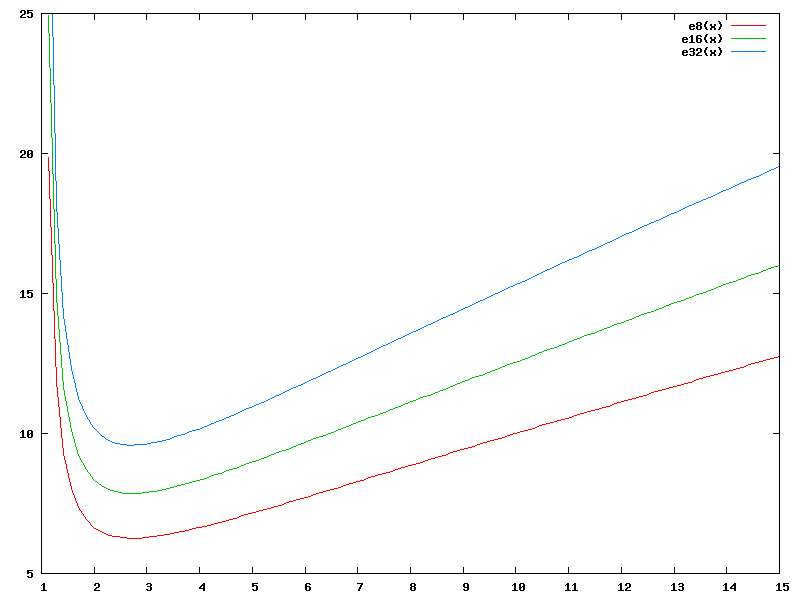
[*] – Σκέψου τα σαν μαύρα και άσπρα πούλια του τάβλι. Χρειάζεσαι 8 μαύρα και 8 άσπρα για να μπορείς να παράγεις όλους τους συνδιασμούς.

