
Αυτό είναι μάθημα.
Author: adamo
I am a Greek DevOps Engineer ranting about everything, from email to sports; to living in Athens, Greece.
Νέο avatar
| Μετά από πολυετή παράπονα της συζύγου και αντίστοιχες παραινέσεις στο GBC08, άλλαξα το avatar. Η φωτογραφία είναι δια χειρός Ma.tt. |  |
Μηχανική κίνησης
Traffic engineering
Από την Ελληνική μετάφραση του Wireless Communications and Networks.
Ααααργκ!!!!
H μέρα του πατέρα
Για να μη ξεχνιόμαστε, είναι σήμερα. Είναι η τρίτη Κυριακή του Ιουνίου.
re: My Desktop
| Το ζητήσανε ο HSOC και ο Δημήτρης. Μόνο που …δεν έχω desktop: | 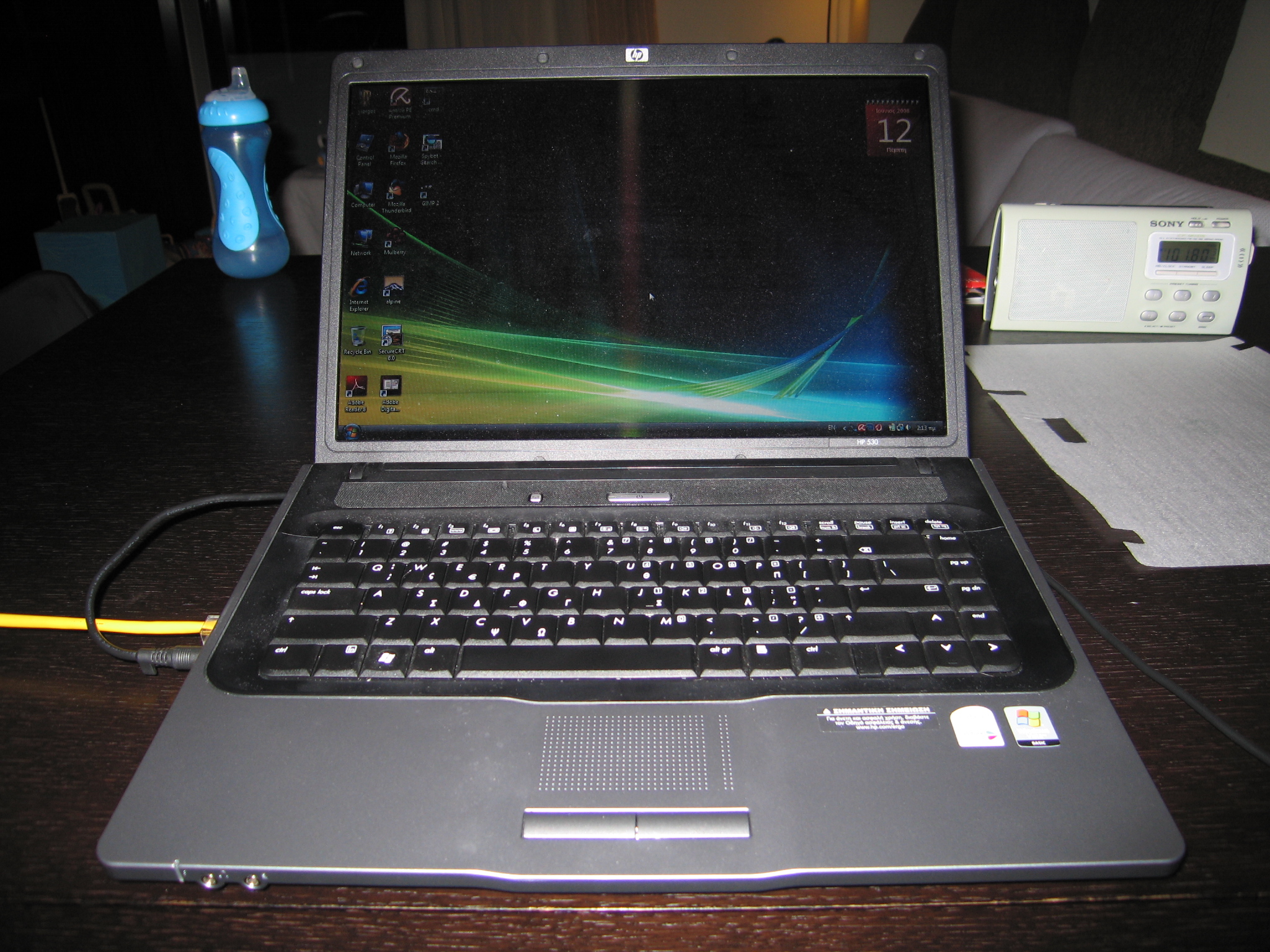 |
Είμαι στο τραπέζι του σαλονιού. Όχι τόσο μινιμαλιστικό surrounding όσο αυτό στο unclutterer δηλαδή. Διακρίνονται ένα ραδιοφωνο (που παίζει “Παρέα με τα Νούμερα“) το προστατευτικό οθόνης-πληκτρολογίου του laptop, ένας καναπές και το μπουκάλι νερού του μικρού. Α ναι, το laptop στηρίζεται σε δύο λαστιχένιες σφήνες που κανονικά κρατάνε πόρτες. Ιδέα που πήρα από το lifehacker.
Η πρόσκληση επεκτείνεται στον Ντροπαλό και τον Brute Force.
On documentation…
Γράφει ο Terry Zink*:
“It gets tense when stuff breaks that hasn’t broken in a long time because nobody can remember how to fix it. When you do it once and then leave it, it doesn’t always stick in our memories.”
Είχα την εντύπωση πως σε οργανισμούς που δουλεύουν με παραπάνω από 1,5 Postmaster δεν συμβαίνουν αυτά…
[*] – Ο Terry Zink εργάζεται στο Microsoft Exchange Hosted Services antispam division.
Graph Theory
15+ years ago as an undergraduate I was interested in graphs. Manos then suggested that I should read Christos‘ PhD thesis. Then came work. Then came this paper. Then came even more work. I forgot about graphs. My interest was renewed after spending family vacations with a theorist’s family. Aris presented me with a challenge, while this fall, this man taught me the foundations from a non-CS perspective.
In the words of Steve Yegge:
“Graphs are, like, really really important. More than you think. Even if you already think they’re important, it’s probably more than you think.”
Notice the “really really important” part. For it is not “really2 important”; rather it is more of “reallyn important” (for n >> 2). Go down to your library and read Bela Bollobas’ “Modern Graph Theory” (I found its predecessor “Graph Theory – An Introductory Course”) or even Reinhard Diestel’s “Graph Theory” which is also available online*. For those who read Greek, here is a quick introduction (definitions and theorems but no proofs): Εφαρμογές Θεωρίας Γραφημάτων.
In an era when (almost) everyone seems to be talking about the social graph, or applications that make use of it, you need the mathematical background. If you have an idea that builds on social networks it is almost inevitable that its development and implementation will make use of theorems or more general results of graph theory. So, since you will have to deal with it, why not be prepared? Or even if you have devised a graph data model that can kill the RDBMS+, why not use the theory to support the argument?
[*] – Originally I wanted to write a simple “post-it” on Diestel’s book. However, in the process I decided to make it a typical blog post of three to four paragraphs. You may even want to dig more by reading Bernie Hogan’s “Using Information Networks to Study Social Behavior: An Appraisal “, the stuff over at the NetWiki and the articles in the graph theory section of MarkCC’s Good Math, Bad Math.
[+] – Hank, this is not a polemic on your view on RDBMS; we have already agreed on what parts of this view we disagree.
Why I like running MIMEDefang
I had a talk with a friend the other day and he told me that he does not run MIMEDefang on his systems. Well I do and since most people run MIMEDefang just to be able to run ClamAV and SpamAssassin from one place, I want to explain why. Because when you have a hammer it is better to have more than two nails.
I like running MIMEDefang because it gives me a Perl interpreter at hand and a set of handy routines to manipulate every message that passes through the mail server (header and body). So for any weird idea that I have and I need a proof of concept, I have a full programming language on my email server waiting to run it. And if I have performance issues, well I can always (re)write it in C.
I really think it pays off to invest sometime to learn how to change stuff in mimedefang-filter(5) and how to write your own versions of the filter_* routines.
1 μήνας off
Ελληναράδικη Οδήγηση
Σχολιασμός αυτού του αυθεντικού στυλ οδήγησης από τον GreekDriver.

