
Κυβερνοσφετερισμός: Εξαιρετική μετάφραση του cybersquatting. Ήρθε στην αντίληψή μου από τον e-lawyer.
Tag: Internet
Hellenic IPv6 Taskforce
Από το δελτίο Τύπου:
Με πρωτοβουλία του Εθνικού Δικτύου Έρευνας και Τεχνολογίας (ΕΔΕΤ ΑΕ) και της Εθνικής Επιτροπής Τηλεπικοινωνιών και Ταχυδρομείων (ΕΕΤΤ), οργανισμοί, φορείς, πάροχοι υπηρεσιών διαδικτύου, εταιρίες δικτυακού υλικού, λογισμικού & υπηρεσιών ενώνουν τις δυνάμεις τους, δραστηριοποιούνται για την έγκαιρη και αποτελεσματική μετάβαση στο νέο πρωτόκολλο επικοινωνίας του Διαδικτύου, Internet Protocol IPv6, και δημιουργούν την ανεξάρτητη Ομάδα Δράσης, Hellenic IPv6 Task Force, για την Προώθηση της Τεχνολογίας IPv6 στην Ελλάδα.
Περισσότερα στο www.ipv6-taskforce.gr (όταν ετοιμαστεί).
re: blogdeath
Διαβάζοντας το “Ενάντια στη μελαγχολία” του Ματθαίου Τσιμιτάκη, έπεσα πάνω στο σχόλιο του Μανώλη Ανδριωτάκη:
Γεννιέται ένα ερώτημα: Θα έπρεπε να περιμένουμε ποιοτικές διαφοροποιήσεις;
Από ότι καταλαβαίνω* ο Μ. Ανδριωτάκης τις περίμενε. Εγώ πάλι όχι. Ας δούμε γιατί:
Για την ανάλυση της άποψής μου θα χρησιμοποιήσω τον νόμο του Metcalfe ο οποίος μας λέει πως η αξία ενός δικτύου είναι ανάλογη του τετραγώνου (~n2) των χρηστών του συστήματος.
Εφαρμόζοντας το νόμο σήμερα θα μπορούσε να καταλάβει κανείς πως αλλάζει αξία το οικιακό του δίκτυο (π.χ. με τρεις υπολογιστές) συνδεόμενο με το Internet. Εάν για λόγους απλότητας πούμε πως η αξία του δικτύου είναι V(n) = n2, τότε από το 9, λόγω της συμμετοχής σε ένα ευρύτερο δίκτυο η αξία γίνεται πολύ μεγαλύτερη. Ανάποδα εάν το δούμε, το κέρδος για ένα μεγάλο δίκτυο δεν είναι ιδιαίτερα μεγάλο με την προσθήκη ενός κόμβου. Π.χ. η διαφορά (109 + 1)2 – (109)2 ~ 2 x 10⁹ αλλά η μεταβολή στην αξία του μεγάλου δικτύου είναι ελάχιστη (~ 2 x 10⁻⁹).
Αντίστοιχους υπολογισμούς μπορούμε να κάνουμε και για την μπλογκόσφαιρα (όπου μπλογκόσφαιρα ορίζουμε το σύνολο μπλογκς με μια κοινή ιδιότητα, π.χ. Ελληνική Μπλογκόσφαιρα). Γραφικά το κέρδος† (ποιότητα) για κάθε blog που προστίθεται σε ένα ήδη υπάρχοντα πληθυσμό από blogs, μπορεί να παρασταθεί ως εξής: 
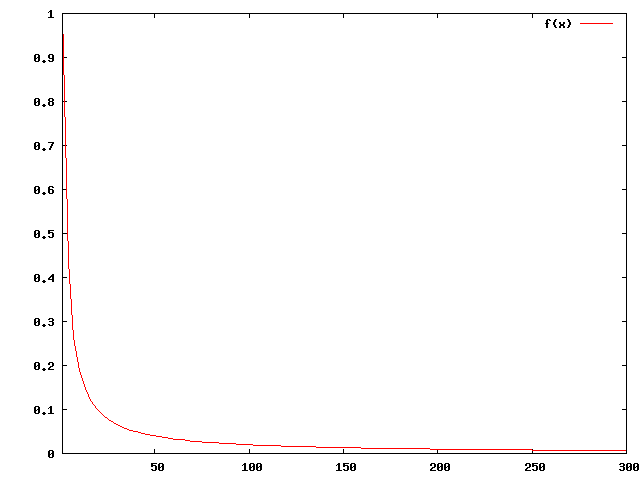
(Το 300 το διάλεξα γιατί κάπου εκεί, αλλά λιγότερα, είναι τα feed που παρακολουθώ.)
Είτε έχουμε να κάνουμε με ένα aggregator που προσπαθεί να απεικονίσει μια μπλογκόσφαιρα, είτε έχουμε να κάνουμε με ένα προσωπικό feed reader, κάθε νέο προστιθέμενο blog προσφέρει ακόμα λιγότερο κέρδος από το προηγούμενο για το χρήστη. Και αυτός είναι και ο λόγος που τελικά αφαιρούμε feeds από τους feed readers μας. Γιατί μας ενδιαφέρει το fat head και όχι το long tail στις λίστες που φτιάχνουμε.
Εν τέλει, αυτό που θέλω να πω είναι πως το γεγονός πως οι ποιοτικές διαφοροποιήσεις (για οποιοδήποτε ορισμό της ποιότητας) δεν ακολουθούν τον ρυθμό αύξησης των ιστολογίων είναι κάτι αναμενόμενο που δεν πρέπει ούτε να μας εκπλήσσει, ούτε να μας απογοητεύει.
Related post: Metcalfe’s Law.
[*] – Ο Μ. Ανδριωτάκης λέει πως κατάλαβα λάθος.
[†] – Για τις ανάγκες αυτού του post οι έννοιες κέρδος και ποιοτική διαφοροποίηση ταυτίζονται.
[‡] – Ευχαριστώ Stazybo Horn για τη διόρθωση.
Debian Etch, iceweasel and libflashplayer.so version 10
It simply does not work. Version 10 of libflashplayer.so requires GLIBC 2.4 while Etch (4.0r5) comes with GLIBC 2.3.6.
re: 8 Things I Hate About The Web
Boris Veldhuijzen van Zanten writes about 8 things he hates about the web. I tried commenting under his post, but failed (which is somewhat common when replying using OpenID) so here are my comments:
Boris’ points:
- Too Cheap. He asks “How much longer will it take until we will have a healthy online economy for start-ups?”. Well, Geoff Huston answered this in one of his brilliant presentations in RIPE-54. In his own words: “You people are cheap! No matter what scientists and engineers do your users will always be looking for the cheapest provider”. This was said while explaining the implications of an earthquake in southeast Asia on the Pacific cables and the Internet connectivity.
- Too Many Bugs. I am reading “The New School of Information Security” these days. In its pages it is clearly explained that today, security is not a priority when building a product. And yes, although this covers a fraction of the bugs, getting the product out seems more important than getting the product out bugless. The first part of the “Unifinished Revolution” deals with the subject in depth. Boris asks: “How hard is it exactly to build a browser that works?” You cannot begin to imagine.
- Too Many Choices. While I am not a friend of too many choices either, given enough time, the fittest choices will survive. I understand that the problem exists when you are at the start of the timeline, when all choices seem viable (or equally crappy). No we cannot do something about it.
- Too Many Browsers. IMHO, this is equal to Too Many Choices (the choice being the browser to use). Standardization is an issue, but we all know that incompatibility with standards occurs when certain groups want to impose their options as default standards for others. When critical mass is gathered, they become de-facto standards. You cannot really hate the web for that. It is a common human / corporate behavior and it is expected.
- Too Many Search Results. Well, I believe that one can develop systems that return few and important results as Boris wants. The drawback is that you have to feed such systems with so many details on what is important to you, that in the end you might not like it.
- Too Many Opinions. Boris writes: “Opinions are just like assholes, everybody’s got one. On the web, we can all show ours to everyone.” I cannot really comment on that, can I?
- Too Slow. The Internet (and not just the Web) will always be too slow. We will always want better speeds and bigger capacities, because there will always be this new thingy that will require the bandwidth. 10 years ago a 1Mbps line was considered enough for a University and today it is considered too slow for my house.
- Too Many Passwords. Boris asks about OpenID: “Why the hell isn’t it implemented everywhere yet?” Because as it is pointed out in “The New School of Information Security“, everyone expects everybody else to deploy it before deploying it themselves. So generating the critical mass that will make OpenID commonplace will take time, regardless of the recognized need to use such schemes.
Boris, I think that what you hate is certain human and corporate behavior as it is projected on the web, and not the web itself. For as with most problems, the technical part of the solution is the easy one, while the social and economic parts are the most difficult to get accepted.
Internet Worm – 20th anniversary
It has been 20 years since the Morris Worm hit the Internet. David Alan Grier writes:
“Even though Morris had violated the network community’s standards, he found a fair amount of sympathy among his peers. “I don’t know of too many who want to see this kid rot away for the next few decades in a jail,” commented one computer scientist. The researchers acknowledged Morris as one of their own, an individual who had demonstrated bad judgment and seemed to be aware of his error.”
and some lines below he observes:
“De Guzman found no sympathy from computer scientists, business students, or the computer industry. Even though he made a few statements about the freedom of the Internet, these ideas found no sympathetic ears in the US. Most network users were disappointed when de Guzman did not have to face prosecution on charges of disrupting the Internet.”
It only took ten years for the suits to take over the Internet and (with the help of spammers, virus writers and botnet herders) to change our mindset on people’s mistakes. Then again, Morris took down a research network, while De Guzman’s pet was released on a commercial platform…
The Second International Workshop on NS-2
On Thursday I attended the second international workshop on ns-2 which took place at the hotel Amarilia. Since the main conference lounge was reserved for VALUETOOLS, the workshop presentations were given at a smaller room. Some quick observations:
- Why does every small conference room in Greek Hotels have paintings of small fishing boats?
- People! Please rehearse your presentation in the language you are going to give it! You must never run out of time!
- Please find a way to block internet access where the actual sessions take place. How would you like it to be giving a presentation, only to see that your audience just bangs away on their keyboards instead of paying (or trying to pay) attention to what you are saying?
I particularly liked the following presentations:
- Simulation of wireless multi-* networks in ns-2 by Laurent Paquereau and Bjarne Helvik.
This was judged as the best paper of the workshop. If you live and die by ns-2 code, you must read it.
- Implementation of an IPv6 stack for NS-3 by Julien Montavont, Sebastien Vincent and Nicolas Montavont.
Very interesting work! It is going to be merged in version 3.3 of ns-3. You can see more at http://ns3v6.enstb.fr.
- XAV: A Tracing Framework for Exploring Large Network Simulation Outputs by Ryad Ben-El-Kezadri, Guy Pujolle and Farouk Kamoun.
Oh how I wish I had known of XAV last year when I was madly scripting awk and perl over gigabytes of ns-2 traces! I particularly liked the idea of using a data cube in order to do the trace analysis, instead of the normal ns-2 trace files. And although I am not a big fan of columnar databases, I find it rather interesting to use MonetDB as the database backend (for more columnar database propaganda go to the Database Column).
Tutorial on NS-3
This is the real reason I attended the workshop. The tutorial was given by Dr. George Riley. He is an excellent presenter and it is a pity that this tutorial was not taped. The presentation slides cover all the main points of his talk, so I want to focus on some peripheral stuff that I found interesting:
- In the words of George Riley himself: “When I reached 45, both me and my wife watched each other in the eyes and decided that we needed something else professionally. So we both enrolled in PhD programs, got our PhDs and joined the academia”. Silence full of admiration covered the room.
- ns-3 is not the same thing as ns-2. There is no Tcl, nor are any Tcl bindings planned (most of the audience seemed to like this fact). In ns-3, the simulations are programmed in C++, although one of the lead developers has contributed bindings in Python. I think this is an opportunity for the SmallTalk crowd to continue in the spirit of “SmalTalk-80: The Language“* and provide hooks for ns-3 (Part III of the book describes simulation classes and ns-3 is a discrete event simulator).
- There is no compatibility between ns-2 and ns-3. NS-3 is more of a spiritual successor of ns-2.
- There is no nam for ns-3.
- The simulator’s core is very robust and generic. At one time they even thought of releasing it separately.
- ns-3 development is going to be funded for two more years by the NSF. However one of the full time developers is fully sponsored by INRIA.
- Different simulation platforms give different results even for the same scenarios. One has to be careful and read “On the Accuracy of MANET Simulators“ (.ppt slides here).
- When reading comments in ns-2 code be careful. There are lots of comments that are really older than the code beneath them, sometimes to the point of being irrelevant. Yes people when you patch / change / improve code, you have to patch / change / improve comments too. At the very same moment, not later because you will not. And lots of people will bang their heads on the wall because they will believe the comment first. Hey! Even no comments is better than irrelevant comments.
From what I saw and heard, if your simulation involves protocols already implemented in ns-2, go ahead and use ns-2. If on the other hand you are going to implement some new functionality or protocol that you are willing to study, ns-3 is a much more promising platform.
As usual, the most interesting stuff in conferences and workshops happens during the breaks. When you bump into old friends, exchange news and ideas, learning about interesting tools like scapy, VNUML, PRIME and books like “Analytical Network and System Administration: Managing Human-Computer Systems“.
All in all, attending this workshop was money well spent.
[*] – You can download a copy of a previous edition of the book from the ACM classics.
traceroute
traceroute: Ένα παρεξηγημένο εργαλείο.
Πριν κάτι μέρες έφτασε στο mailbox μου η διαμαρτυρία ενός συνδρομητή (όπου χρειάζεται τα ονόματα έχουν αλλαχτεί):
Για πολλοστή φορά είναι αδύνατη η επικοινωνία της σύνδεσης που έχουμε στο internet μέσω ΤΕΕ με τον server της mitsosworks.
Είναι σίγουρο ότι πάλι υπεύθυνο είναι το ΤΕΕ αφού η mitsosworks μας λέει ότι το πρόβλημα με το ΤΕΕ είναι γνωστό και με άλλους πελάτες και δεν φαίνεται καν επικοινωνία με τον δικό τους server
Τι έχει συμβεί και εξοργίζει τον συνδρομητή; Έχει μια σύνδεση με εμάς και κάνει το web hosting της εταιρίας του στη mitsosworks. Το πρόβλημα; Δεν μπορεί να στείλει email ούτε από εμάς προς εκεί, ούτε από εκεί προς εμάς.
Η γρήγορη διάγνωση της mitsosworks; Το ίδιο πρόβλημα έχουν και άλλοι πελάτες της mitsosworks, ταυτόχρονα δεν έχουν πρόβλημα με κανένα άλλο δίκτυο, άρα είναι πρόβλημα δικό τους.
[ Πριν συνεχίσω: Δεν έχουμε το καλύτερο δίκτυο, δεν είμαστε οι καλύτεροι, δεν έχουμε τις καλύτερες υπηρεσίες και σίγουρα δεν έχουμε τις φτηνότερες. Δεν το έχουμε ισχυριστεί ποτέ αυτό. Αλλά σίγουρα όταν μαθαίνουμε για ένα πρόβλημα, το κυνηγάμε εξαντλητικά. ]
Για να είχε μια δόση σιγουριάς ο ισχυρισμός της mitsosworks, θα έπρεπε η αναμεταξύ μας σύνδεση να είναι κάπως έτσι:

Στην πραγματικότητα η σύνδεση είναι έτσι:
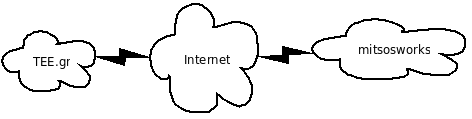
Πολλά πράγματα μπορούν να πάνε στραβά στο σύννεφο του Internet. Αφού λοιπόν o smtp server που παρέχεται στον συνδρομητή από την mitsosworks είναι ο smtp.mitsosworks.biz, ένα
$ traceroute smtp.mitsosworks.biz
αποκαλύπτει την τοπολογία και δείχνει που μπορεί να βρίσκεται το πρόβλημα:

Το βέλος δείχνει που μπορεί να βρίσκεται το πρόβλημα σε μια πρώτη επισκόπηση των αποτελεσμάτων που έβγαζε το traceroute. Τώρα, θα μπορούσαμε να απαντήσουμε και εμείς στον συνδρομητή κάτι της μορφής: “Εντοπίσαμε το πρόβλημα και δεν οφείλεται σε εμάς και το δίκτυό μας. Υπεύθυνοι για το πρόβλημα είναι η εταιρία F.”
Τόσο απλά και λακωνικά θα είχαμε τελειώσει σε ότι μας αφορούσε και για το πρόβλημα του πελάτη και για τη σιγουριά (;) της mitsosworks για το ποιος ευθύνεται.
Θα λυνόταν το πρόβλημα του ανθρώπου; Όχι βέβαια.
Παίρνουμε τηλέφωνο την εταιρία F, που είναι ένας από τους upstream provider μας και βρίσκουμε πως η πραγματική τοπολογία είναι η:
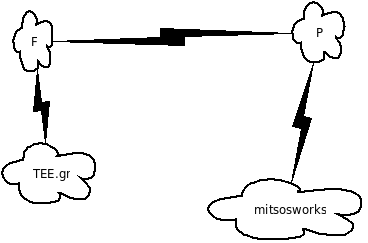
Όπου P ο network provider της mitsosworks. Ακολουθεί απόσπασμα από το email της F σχετικά με το θέμα (τα bold δικά μου):
Σε έλεγχο που έγινε διαπιστώθηκε ότι το xx.yy.0.0/17 ανακοινώνεται μέσω του national bgp, παρόλαυτα επειδή έχει αλλάξει η δρομολόγηση για το δίκτυο αυτό και δεν γίνεται μέσω F αλλά από international δίκτυο, η πρόσβαση από το ΤΕΕ δεν είναι εφικτή.
Στην τηλεφωνική μας ερώτηση “Και γιατί δεν αλλάζετε το national bgp σας τότε;” μας απαντήθηκε “Μα δεν μας έχουν ενημερώσει για την αλλαγή αυτή, είναι πελάτες και δεν μπορούμε εμείς να την κάνουμε αυτοβούλως”. Fair enough.
Και πάλι θα μπορούσαμε να ενημερώσουμε τον συνδρομητή σχετικά, και να σταματήσουμε εδώ. Ήταν δικιά μας ευθύνη; Όχι. Θα λυνόταν το πρόβλημά του; Όχι.
Ρωτάμε λοιπόν την F, “ΟΚ επειδή εμείς θέλουμε να τον βοηθήσουμε τι προτείνετε να κάνουμε;” και η απάντηση ήταν να υλοποιήσουμε μια εξαίρεση. Την υλοποιήσαμε. Η σύνδεση αποκαταστάθηκε. Αποκαταστάθηκε προσωρινά φυσικά γιατί κανείς δεν ξέρει πότε και χωρίς να ενημερώσει κανένα ο P, θα ξανααλλάξει το routing policy.
Και σκέφτομαι τώρα:
- Ένας άνθρωπος έχει πρόβλημα. Το περιγράφει (καλά / κακά δεν έχει σημασία) στον προμηθευτή της υπηρεσίας του.
- Ο προμηθευτής για να “κρατήσει” τον πελάτη δεν ψάχνει το ζήτημα, αντίθετα του αναφέρει και άλλα συμπτώματα, τα βαφτίζει ως πρόβλημα και ερεθίζει τον πελάτη.
- Ο πελάτης στρέφεται εναντίον του άλλου προμηθευτή υπηρεσιών και τον κατηγορεί για ένα πρόβλημα που ποτέ μέχρι εκείνη τη στιγμή δεν ήταν σε γνώση του προμηθευτή #2.
- Ο προμηθευτής #2 βρίσκει το πρόβλημα, διαπιστώνει πως δεν είναι δικό του και ενημερώνει σχετικά τον πελάτη. Βρίσκεται τώρα σε δίλημα: Να υλοποιήσει μια εξαίρεση “για να κάνει ο άνθρωπος τη δουλειά του”; ή να κάνει το “σωστό” και να μη μπορεί να κάνει ο άνθρωπος τίποτε;
Πόσος χρόνος και κόπος πήγε χαμένος γιατί κάποιος για να ξεφορτωθεί την καυτή πατάτα δεν έτρεξε ένα traceroute;
ΒΑ-ΡΕ-ΘΗ-ΚΑ
#include <std/disclaimer.h>
Update: So you think you know traceroute?
Future disclaimer: Το domain mitsosworks.biz δεν υπήρχε σε χρήση όταν γραφόταν αυτό το κείμενο
re: Meet Firestatus
chstath writes:
“But your friends don’t seem to have reached a consensus about THE social network”
So why not try and build a meta-social network platform? I once read that “Social network platforms are islands condemned to communicate via SMTP. It’s BBS all over again!”*. Oh wait, Firestatus seems to be that kind of glue too! Good work guys. Now please integrate with SMTP. You have friends that neither follow you on twitter, nor are subscribed in any social network platform and miss references like this one.
:)
(In-ReplyTo:)
[*] – Unfortunately, I cannot find the reference
OneWebDay
Η 22η του Σεπτέμβρη είναι η OneWebDay, μια προσπάθεια εορτασμού του Internet και των αλλαγών που φέρνει στη ζωή μας. Δυο χρόνια πριν έγραψα τη δική μου ιστορία. Έτσι για φέτος σκέφτηκα να ξεκινήσει ένα tag game: Θα ήθελα λοιπόν να διαβάσω πως άλλαξε τη ζωή τους και τι σημαίνει το Internet για δύο ανθρώπους που ζουν από αυτό, τον apostolo και τον Vaggeli και τι σημαίνει για δύο άλλους, για τους οποίους δεν είναι το “line of business” τους, τον Ντροπαλό και τον Μπαμπάκη.
Update: Implicit invitation to HSOC :)
 Managing organized complexity